

Key Takeaways
- A capsule wardrobe focuses on versatile, mix-and-match pieces rather than volume.
- Auditing what you already own is the essential first step before spending anything.
- Neutral colors and simple silhouettes multiply outfit combinations dramatically.
- Thrift stores, clothing swaps, and end-of-season sales are practical budget strategies.
- Proper garment care extends the life of inexpensive clothes significantly.
- Small tailoring adjustments can transform the look of budget-friendly finds.
Start here
What Is a Capsule Wardrobe?
Next
Audit What You Already Own
Then
Choosing Your Core Pieces
After that
Shopping Smart on a Tight Budget
Finally
Making Every Piece Work Harder
What Is a Capsule Wardrobe?
A capsule wardrobe is a curated, intentionally small collection of clothing where every piece can mix and match with the others. The concept was popularized in the 1970s by London boutique owner Susie Faux, who argued that a few well-chosen garments served people better than a closet stuffed with impulse buys. The idea has only grown more relevant as budgets tighten and closets overflow.
The core promise is simple: own fewer items, get dressed more easily, and look more put-together on any given day. A capsule wardrobe is not a minimalist uniform or a luxury exercise — it's a practical framework that works at any income level. For value-conscious shoppers, it's actually one of the smartest financial moves you can make, because it shifts focus from quantity to utility.
Capsule wardrobe
A small, deliberately chosen collection of clothing where every item pairs easily with the others, reducing decision fatigue and unnecessary spending.
Versatile piece
A garment that works across multiple outfits, settings, or seasons — maximizing how many times you actually wear it.
Neutral color palette
A group of colors — like black, white, navy, grey, and tan — that coordinate naturally with almost anything, making mix-and-match dressing much easier.
Cost-per-wear
A simple way to evaluate clothing value: divide the item's price by the number of times you expect to wear it. A $40 jacket worn 80 times costs $0.50 per wear.
Clothing swap
An event where people exchange clothes they no longer wear, allowing participants to refresh their wardrobes at no financial cost.
Wardrobe audit
A deliberate review of everything you own to identify what you actually wear, what fits well, and what gaps your wardrobe has.
Audit What You Already Own
Before spending a single dollar, pull everything out of your closet. This step is non-negotiable. Most people discover they already own several capsule-worthy pieces hiding behind impulse purchases they never wear.
Sort items into three categories: Keep (fits well, worn regularly, mixes with other pieces), Consider (good quality but rarely reached for — why?), and Remove (doesn't fit, worn out, or simply wrong for your life). Be honest. A blouse you've owned two years and touched zero times is not an asset.
After your audit, note the gaps. Maybe you have plenty of tops but no versatile trouser. Maybe you have five similar casual tees but nothing that works for a dinner out. Those gaps — not impulse buys — are what your budget should address. Connecting your wardrobe goals to a realistic spending plan is easier when you have a framework; our smart budgeting guide can help you set one up before you shop.
Choosing Your Core Pieces
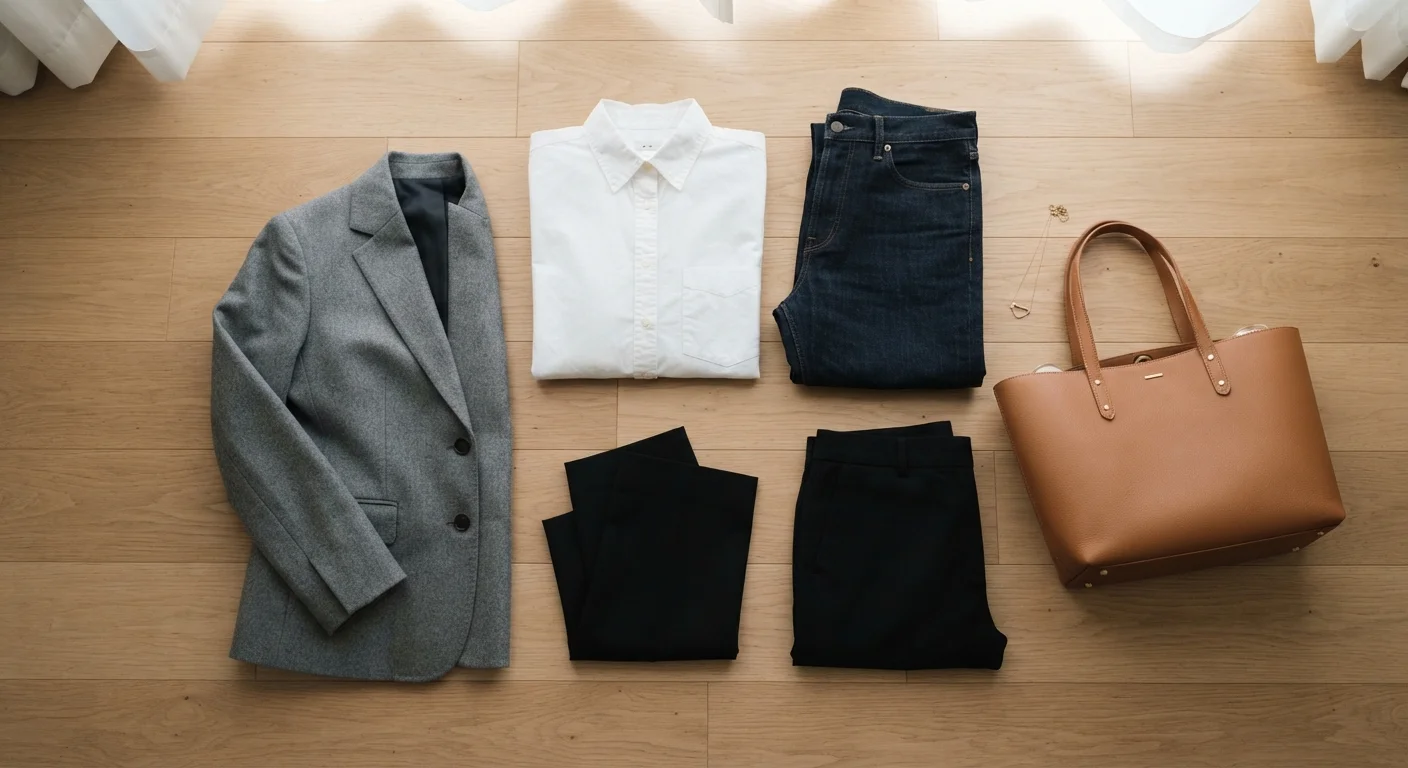
A practical budget capsule wardrobe typically revolves around a handful of categories:
- Bottoms: Dark-wash jeans, tailored trousers in a neutral (black, navy, or tan), and one casual option like chinos or a simple skirt.
- Tops: White or cream button-down shirt, a few solid-colored tees or tanks, and one lightweight sweater or pullover.
- Layers: A structured blazer or cardigan, and a versatile jacket suited to your climate.
- Shoes: Clean white sneakers, one pair of flat or low-heeled dress shoes, and a casual everyday option like loafers or ankle boots.
Notice that nothing on that list requires a designer label. Neutral colors are the engine of this system — they multiply combinations automatically. For a deeper dive into how colors and patterns interact to expand your outfit count, see our guide on colour and pattern strategies for a small wardrobe.
If you need pieces that cross into professional settings, the same capsule logic applies there too — check out our tips on dressing professionally on a limited clothing budget.
Shopping Smart on a Tight Budget
Once you know exactly what you need, you can shop with precision instead of browsing aimlessly. A few approaches that consistently deliver value:
- Thrift and consignment stores: Secondhand shopping is one of the most reliable ways to find quality garments at a fraction of their original cost. Natural fibers like cotton and wool — which hold up and look polished — often show up at thrift prices.
- End-of-season clearance: Retailers mark down seasonal inventory significantly. Buying a winter coat in February or summer linen trousers in August takes planning but pays off.
- Clothing swaps: Organizing or attending a swap with friends or neighbors costs nothing and can refresh your capsule without any spending at all.
- Online resale platforms: Secondhand marketplaces have grown substantially, making it easier to find specific items in the right size and condition.
Try on before you commit
Even when shopping secondhand or on clearance, always try items on or check measurements carefully before purchasing. Fit issues that seem minor in the store often become reasons the piece never gets worn. A garment that fits your life and your body is far more valuable than one that was simply inexpensive.
Fit is the single biggest factor in whether an inexpensive garment looks polished or cheap. A $15 blazer that fits your shoulders perfectly will outperform a $100 one that doesn't. Minor adjustments like hemming trousers or taking in a side seam are often inexpensive and transformative — learn which fixes offer the most payoff in our article on budget alterations that make inexpensive clothes look expensive.
Making Every Piece Work Harder
The real value of a capsule wardrobe comes from how you use it. Outfit formulas — reliable clothing combinations — like a blazer over a tee with dark jeans, or a button-down tucked into tailored trousers — give you a dependable structure to build from every morning. Learning a handful of these combinations means your capsule serves you for casual weekends, work, and evenings out. For more structured daily dressing inspiration, explore outfit formulas that simplify getting dressed every day.
Care is just as important as selection. Washing clothes inside-out in cold water, air-drying when possible, and storing knitwear folded rather than hung significantly extends the lifespan of budget garments. Our guide on how to care for inexpensive clothes so they last longer covers these habits in practical detail.
Building a wardrobe that genuinely serves your whole life — not just one occasion — is also within reach. See how to think about building a wardrobe that works across multiple occasions as a natural next step once your capsule foundation is in place.
Wardrobe Audit Worksheet
A structured template to categorize your current clothing, identify gaps, and prioritize what to shop for — so your budget goes exactly where it's needed.
Smart Budgeting Hub
Practical strategies for planning purchases and avoiding overspending, useful for setting a realistic clothing budget before you start building your capsule.