

Key Takeaways
- ACV pays what your damaged property was worth at the time of the loss, after depreciation is subtracted.
- Replacement cost coverage pays what it costs to buy or rebuild an equivalent item at today's prices.
- The difference between ACV and RCV can easily run into thousands of dollars on a single claim.
- RCV policies typically carry higher premiums than ACV policies for the same property.
- Your policy documents spell out which method applies - checking now avoids surprises after a loss.
- Some policies offer ACV but let you upgrade to RCV by endorsement for an added premium.
Option A
Actual Cash Value (ACV)
The depreciation-adjusted payout option.
Best for: Policyholders looking to keep premiums lower and who can absorb some out-of-pocket cost after a claim.
Option B
Replacement Cost Coverage (RCV)
The full-replacement payout option.
Best for: Homeowners and renters who want their settlement to cover what it actually costs to replace or rebuild today.
If keeping monthly premiums as low as possible is the priority
Actual Cash Value (ACV)
ACV policies consistently carry lower premiums, making them a reasonable fit when budget is the primary constraint and the policyholder can cover the depreciation gap out of pocket.
If you want your claim check to fully cover rebuilding or replacing what was lost
Replacement Cost Coverage (RCV)
RCV eliminates the depreciation gap, so your payout reflects real current costs rather than an aged value - critical for homeowners whose structures or contents have appreciated over time.
If you own older property or an aging vehicle you could afford to replace without full reimbursement
Actual Cash Value (ACV)
When property has depreciated heavily, the premium savings from ACV coverage may outweigh the reduced payout you'd receive at claim time.
If you have a mortgage lender or landlord requiring full-value coverage
Replacement Cost Coverage (RCV)
Many lenders mandate RCV on homeowners policies to protect their financial interest in the property - ACV coverage may not satisfy those contractual requirements.
What Actual Cash Value Means in Practice
Actual Cash Value (ACV) is a claims payment method that accounts for depreciation - the natural decline in value a property experiences over time due to age, wear, and obsolescence. When you file a claim under an ACV policy, the insurer calculates what your damaged item was worth immediately before the loss, not what it would cost to replace it today.
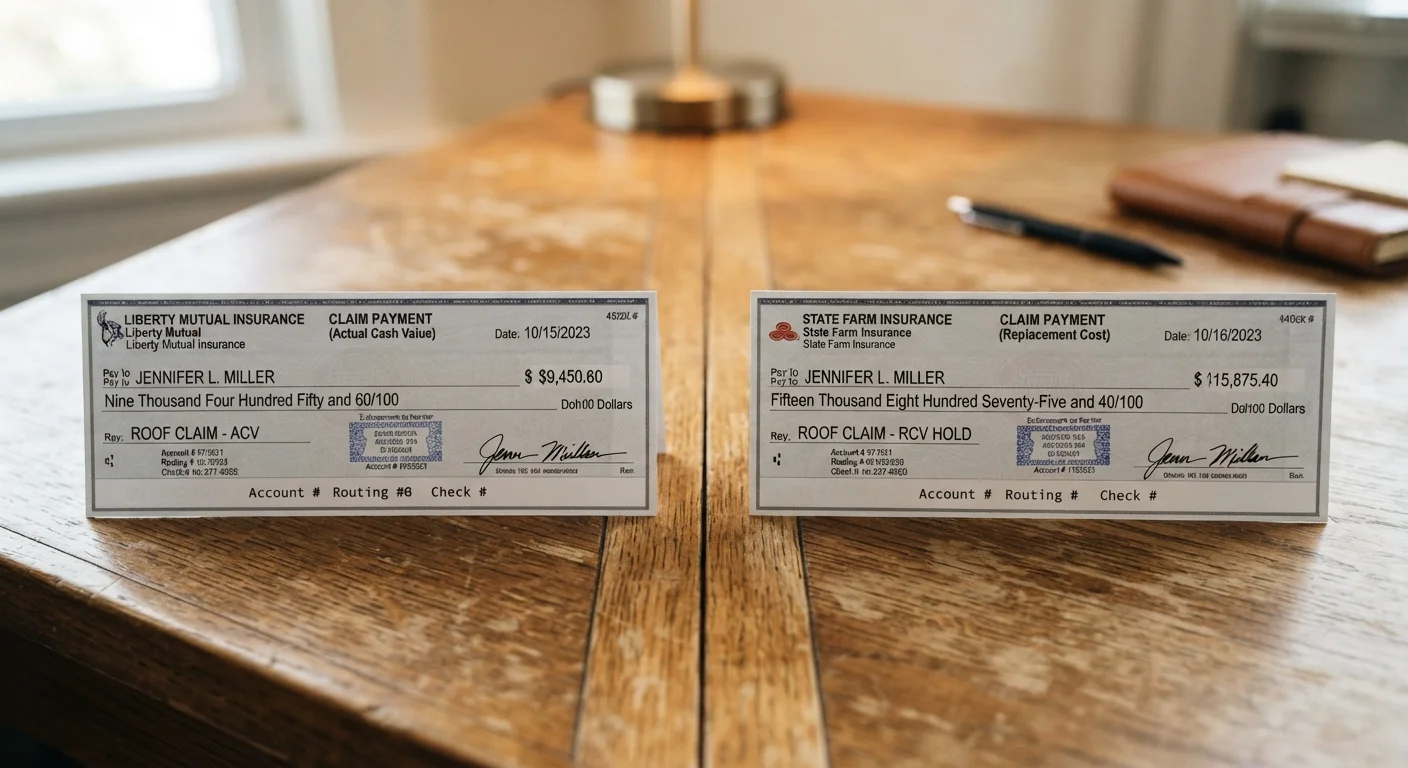
The general formula works like this: ACV = Replacement Cost − Depreciation. A roof that would cost $15,000 to replace today but is 10 years into a 20-year lifespan might be valued at around $7,500 under an ACV calculation. That gap is yours to cover out of pocket.
Depreciation schedules vary by insurer and property type, so two companies can reach different ACV figures on the same loss. For a deeper look at how claim payments work in general, see common misconceptions about claim payouts.
| Criterion | Actual Cash Value (ACV) | Replacement Cost (RCV) |
|---|---|---|
| Payout basis | Current market value minus depreciation | Cost to replace at today's prices |
| Depreciation deducted | Yes - reduces the claim check | No - paid at full replacement value |
| Typical premium cost | Lower | Higher |
| Out-of-pocket risk after a claim | Higher - policyholder covers the gap | Lower - insurer covers replacement cost |
| Common policy types | Basic home, auto, renters | Standard home, optional endorsement |
| Payment timing | Single payment at settlement | ACV upfront; remainder after repairs |
| Best fit | Lower premiums, older/depreciated property | Full financial protection, newer property |
How Replacement Cost Coverage Works Differently
Replacement Cost Value (RCV) skips the depreciation deduction. Instead, the insurer pays what it actually costs - at current market prices - to repair the damage or replace the item with something of like kind and quality. If that same 10-year-old roof needs replacing, an RCV policy would pay closer to the full $15,000 replacement cost, minus your deductible.
In practice, many insurers pay the ACV amount upfront and release the remaining depreciation (called the recoverable depreciation) once repairs or replacement are completed and documented. This matters: if you don't complete the work, you may only receive the ACV portion even under an RCV policy.
For terminology you'll encounter throughout this process, the insurance claims vocabulary reference guide covers terms like recoverable depreciation, proof of loss, and more.
~20%
Typical premium difference between ACV and RCV
Industry analyses generally suggest RCV homeowners policies cost roughly 10-20% more than comparable ACV policies, though figures vary by insurer and property type.
$3,000-$15,000+
Potential depreciation gap on a roof claim
For a mid-aged asphalt roof, the difference between ACV and replacement cost payouts can range from several thousand to over ten thousand dollars depending on roof age and size.
Where the Coverage Gap Adds Up
The valuation method has its biggest impact on high-value, long-lived property: roofs, HVAC systems, appliances, electronics, and the structures themselves. A five-year-old laptop might depreciate 60-70% from its purchase price. A 15-year-old HVAC unit could be valued at a fraction of replacement cost. Across a whole household, these gaps compound quickly.
Auto insurance follows the same logic. When a vehicle is declared a total loss, most standard policies pay ACV - what the car was worth on the market just before the accident, not the dealer price of a comparable new model. Understanding this distinction is explained further in our overview of auto insurance coverage types.
One practical step: review your current policy's declarations page. It will state whether your property is insured for ACV or replacement cost. If it isn't clear, your insurer or a licensed agent can clarify - and in some cases, you can add a replacement cost endorsement to an existing ACV policy for an additional premium. Coverage terms, exclusions, and upgrade options vary by provider and state, so reading the actual policy document is essential.
This article provides general insurance education and is not personalized insurance, financial, or legal advice. Coverage terms vary by provider and state. Consult a licensed insurance agent or adviser for guidance specific to your situation.