

Key Takeaways
- A neutral colour foundation dramatically increases how many pieces you can mix together.
- Limiting yourself to one or two accent colours keeps your wardrobe cohesive and outfit-ready.
- Patterns with your base colours integrate seamlessly rather than creating mix-and-match dead ends.
- Scale and proportion of patterns affect how easily they pair with solids and other prints.
- Intentional colour strategy is one of the most cost-effective wardrobe upgrades you can make.
Why Colour Choices Determine Your Real Outfit Count
Most people think wardrobe size is about how many pieces you own. In reality, it's about how many of those pieces talk to each other. Two items that don't share a colour story sit in your closet untouched; two pieces that do can appear in a dozen different looks. That math — not the number on a price tag — is what makes or breaks a small wardrobe.
The concept is straightforward: every time you add a piece that shares at least one colour with three or more items you already own, you multiply your potential outfit combinations. Add a piece that shares nothing, and you've created a style island — it might be beautiful, but it works alone. For budget-conscious shoppers especially, colour strategy is free. It costs nothing to plan before you purchase.
For a deeper dive into how colour, pattern, and texture work as a visual system, see the visual language of personal style.
~20%
Clothing items regularly worn
Research and wardrobe studies consistently suggest most people wear only around 20% of what they own on a regular basis — a number largely driven by poor colour cohesion.
3×
Outfit combinations from a cohesive palette
Style educators commonly note that a well-coordinated ten-piece wardrobe can generate roughly three times more wearable combinations than a randomly assembled collection of the same size.
Build Around a Neutral Foundation First
Neutrals are the connective tissue of any functional wardrobe. Classic neutrals — navy, white, black, grey, camel, olive, and warm brown — pair with virtually everything, which means every neutral piece you own increases the utility of every other piece around it. Aim for roughly 60–70% of your wardrobe to sit in this neutral band.
The key is to pick your neutrals rather than defaulting to what's on the rack. If you find that camel and cream suit your complexion better than stark black and white, commit to camel and cream as your anchors. Consistency here is what allows you to mix without thinking — you'll reach for pieces instinctively because they already work.
Test Your Neutrals in Natural Light
Neutral tones that look identical under store lighting can clash noticeably in daylight — warm beige against cool grey, for example. When building your neutral foundation, try to assess pieces in natural light before committing. This one habit prevents a surprising number of 'why don't these match?' wardrobe frustrations.
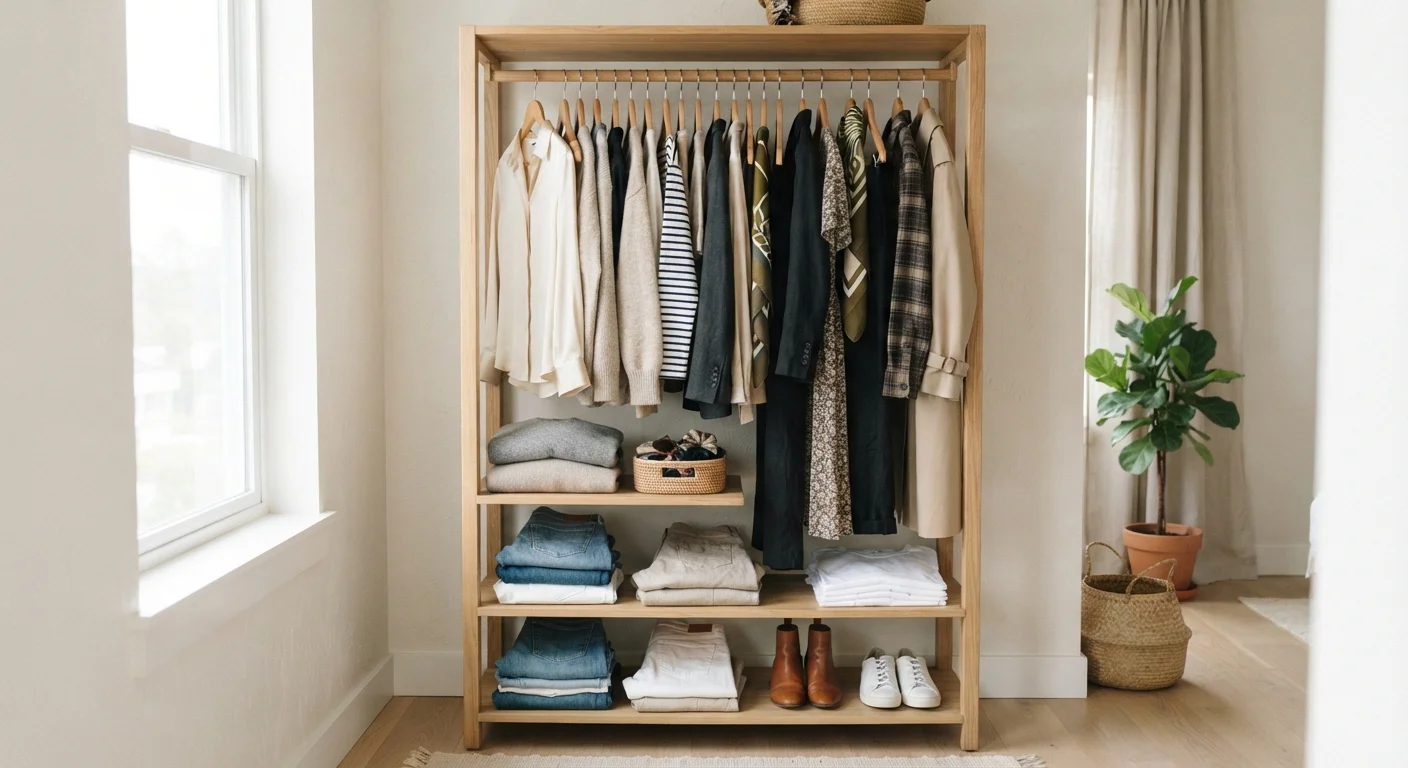
Once your neutral base is set, every patterned or brightly coloured piece you add should echo at least one of those neutrals. A navy-and-white stripe top connects back to both your navy trousers and your white jeans. A camel plaid blazer connects back to a dozen bottoms. Connection is everything.
This approach aligns closely with the principles behind building a capsule wardrobe on a tight budget — choosing pieces with broad compatibility rather than narrow single-outfit use.
Use Accent Colours Deliberately — and Sparingly
One or two accent colours give your wardrobe personality without creating chaos. Think of an accent colour as a thread running through your closet: if rust orange appears in a blouse, a scarf, and a printed skirt, those three pieces already relate to each other and to every neutral you own. Three accent-colour items suddenly generate many more viable looks than three unrelated statement pieces.
The practical rule is to pick accent colours you're genuinely drawn to — ones that work with your skin tone and that you'd happily wear repeatedly — and then stick to that palette when shopping. This is not about limiting self-expression; it's about making sure every purchase earns its place. Wandering outside your palette for one-off pieces is where small wardrobes start to feel cluttered and unwearable.
Anchor every purchase decision to your existing colour palette before buying.
Impulse purchases in off-palette colours create orphan pieces that rarely get worn and drain your budget over time. Checking for colour compatibility before buying ensures every new item multiplies outfit options rather than sitting idle.
Choose patterns whose dominant colour matches a neutral you already own.
A pattern anchored to a neutral you already wear widely integrates instantly rather than requiring you to build an entirely new outfit around it. This is the simplest way to add visual interest without losing versatility.
Limit bold prints to one or two per wardrobe season and make sure they share your accent colour.
Bold prints are high-impact but low-flexibility if their colours don't echo the rest of your wardrobe. Keeping bold prints tethered to your accent colour ensures they still pair with your neutrals.
Use texture to add variety without introducing new colours.
Textured fabrics — ribbed knits, linen, denim, velvet — create visual interest and make repeat outfits feel distinctly different without demanding new colour combinations. This extends the perceived range of a small wardrobe significantly.
Photograph your full wardrobe laid out together before shopping.
Seeing your wardrobe as a whole — rather than piece by piece in a store or online — makes colour gaps and redundancies immediately visible. It's one of the most practical planning tools available, and it costs nothing.
Choosing Patterns That Play Well With Others
Patterns are where most small wardrobes stall. A bold, busy print in colours that appear nowhere else in your closet is a styling dead end — striking on its own, but essentially unwearable with anything you already own. The fix is simple: when evaluating a patterned piece, ask yourself whether its dominant and secondary colours match items already in your wardrobe.
Scale also matters for mix-and-match versatility. A small, low-contrast pattern (fine stripes, a subtle houndstooth, a quiet ditsy floral) pairs far more easily with other pieces than a large, high-contrast print. That doesn't mean large prints are off limits — it means they need to earn their place by connecting back to your neutral and accent colour palette.
When you're ready to get more intentional about how patterns and solids combine, outfit formulas that simplify getting dressed give you a reliable structure to build on. And if you're thinking about the bigger picture of how to approach your style overall, comparing signature style with a capsule wardrobe approach is worth exploring.