

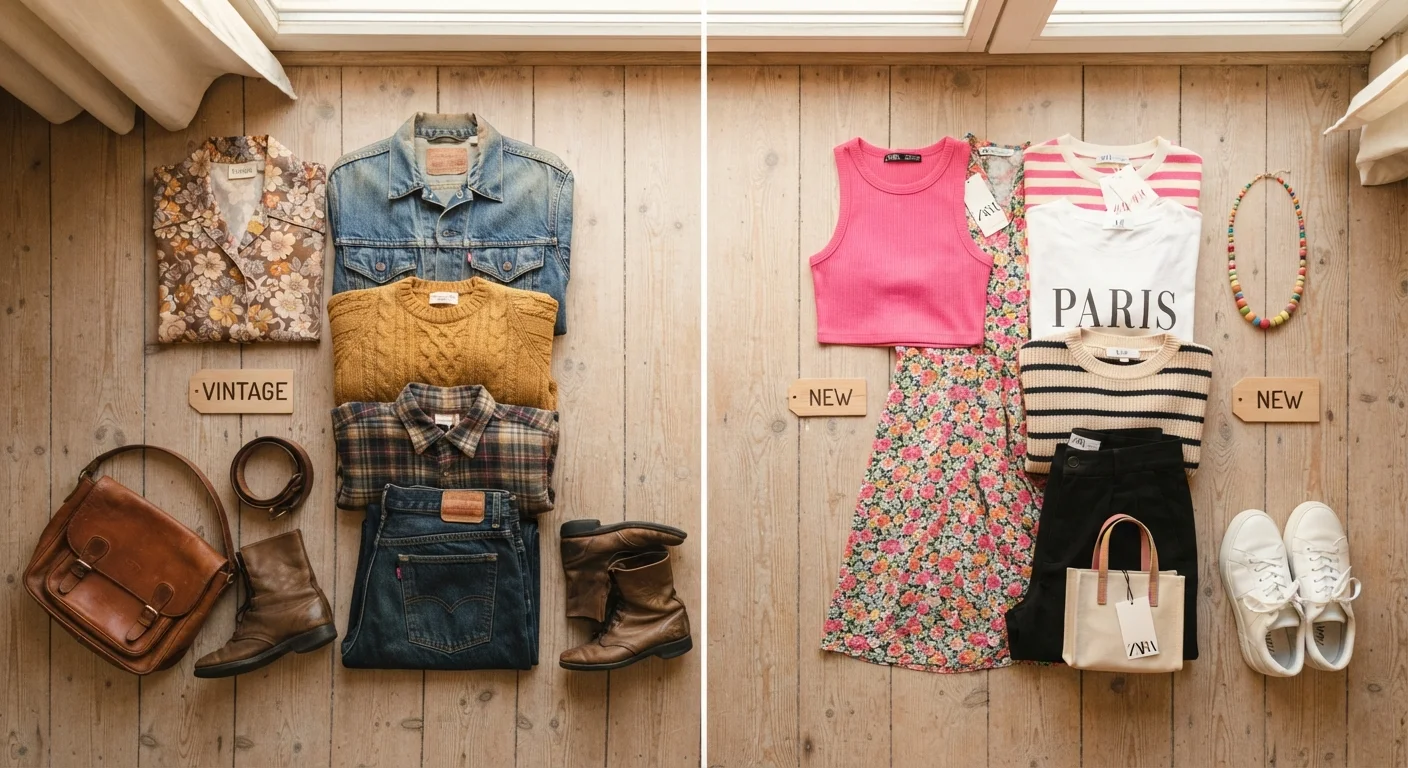
Key Takeaways
- Fast fashion has lower upfront prices but typically shorter garment lifespans, raising long-term cost.
- Secondhand pieces often carry higher individual quality at a fraction of their original retail price.
- Cost-per-wear is a more useful measure of clothing value than sticker price alone.
- Fabric content and construction quality are key signals regardless of where you shop.
- A blended approach — secondhand for basics and staples, budget new for specific needs — often works well.
Option A
Secondhand Shopping
The slower, smarter hunt for lasting value.
Best for: Shoppers who enjoy the process of curating and want quality pieces at reduced prices.
Option B
Fast Fashion
The ultra-accessible, trend-first approach.
Best for: Shoppers who need immediate wardrobe gaps filled quickly and at the lowest upfront cost.
If you want to stretch a tight clothing budget as far as possible over years
Secondhand Shopping
Well-made secondhand pieces at thrift prices can deliver significantly lower cost-per-wear than fast fashion items that degrade quickly.
If you need specific items fast — a particular size, color, or occasion piece
Fast Fashion
Fast fashion offers immediate availability and predictable sizing when secondhand selection simply can't be relied upon.
If you're building core wardrobe staples like denim, blazers, or outerwear
Secondhand Shopping
Staples benefit most from quality construction; secondhand often delivers that quality at prices comparable to fast fashion.
If you're dressing for a short-term trend you won't wear beyond one season
Fast Fashion
For genuinely trend-driven pieces you'll retire quickly, a low upfront fast fashion price may be the pragmatic call.
If you want to reduce how much you spend on clothes annually overall
Secondhand Shopping
Research and consumer surveys consistently suggest secondhand shoppers report replacing garments less frequently, keeping annual spend lower.
The Real Price Tag: Upfront Cost vs. Long-Term Value
When a fast fashion top costs $12 and a thrifted blouse runs $6, it feels like an easy win for secondhand. But pricing in clothing is rarely that straightforward. The more useful question isn't what you paid — it's how many times you'll actually wear something before it's done.
This is the heart of the cost-per-wear principle: divide what you paid by how many wears you get. A $30 secondhand blazer worn 60 times costs $0.50 per wear. A $15 fast fashion version that pills after 10 washes costs $1.50 per wear — three times as much for the same utility.
Fast fashion business models are designed around speed and low material cost. That usually means lighter fabrics, minimal construction reinforcement, and dyes or finishes that fade faster. Secondhand items — especially those from a decade or two ago — were often made to different standards, which is part of why they survived long enough to reach a thrift rack.
| Criterion | Secondhand Shopping | Fast Fashion |
|---|---|---|
| Upfront price | Variable; often very low | Consistently low, predictable |
| Garment lifespan | Often longer (older construction standards) | Typically shorter (cost-driven materials) |
| Cost-per-wear potential | Lower over time for quality finds | Higher if item wears out quickly |
| Size and style availability | Unpredictable; requires patience | Consistent; wide size ranges |
| Fabric quality signals | Varies; check labels carefully | Frequently synthetic blends |
| Time investment | Higher; requires searching | Lower; quick and convenient |
| Environmental footprint | Lower (reusing existing items) | Higher (new production volume) |
What You're Actually Getting From Each Approach
Fast fashion's strongest argument is reliability. You get your size, your color, and a garment that arrives clean, intact, and ready to wear. For shoppers with limited time or very specific needs, that predictability has real value.
Secondhand shopping requires more effort. Inventory is unpredictable; finding your size in a style you love can take multiple visits or searches. But when it clicks, the reward is often substantial — a well-constructed wool coat, a pair of raw denim jeans, or a silk blouse at a fraction of what comparable new items would cost. Understanding how to shop consignment and thrift stores effectively can dramatically improve your hit rate.
One underrated factor: fabric. Fast fashion frequently uses synthetic blends that trap heat, stretch out with wear, and pill quickly. Reading care labels before you buy — at any store — tells you a lot. Our guide to decoding fabric labels breaks down what those tags actually signal about durability and comfort.
~$1,700
Average annual US clothing spend per household
According to the Bureau of Labor Statistics Consumer Expenditure Survey, American households spend roughly this amount on apparel and related services each year.
3x faster
Rate fast fashion garments degrade vs. older construction
Industry observers and textile researchers have noted that modern fast fashion fabrics frequently show visible wear in a fraction of the cycles older garments withstand.
1 in 3
American shoppers who bought secondhand in recent years
Resale platform research and consumer surveys suggest secondhand shopping has grown substantially, with a significant share of US shoppers participating regularly.
Hidden Costs That Change the Calculation
Both approaches carry costs that don't show up at the register. Fast fashion items may need replacing two or three times in the span a single quality piece would last — those replacement purchases add up invisibly. Meanwhile, secondhand finds sometimes require minor repairs or tailoring to fit perfectly. A small hem or seam adjustment is usually affordable, and budget alterations can dramatically improve how any garment looks.
Care costs matter too. Delicate secondhand fabrics — silk, cashmere, fine wool — may need dry cleaning or hand-washing, which adds expense. Conversely, fast fashion's synthetics are often machine-washable but degrade faster under regular laundering. Knowing how to care for inexpensive clothes can extend the life of either type significantly.
One trap worth flagging: the psychology of a deal. A $7 fast fashion shirt feels like a win, but if you're buying five you didn't need because the price felt irresistible, you've spent $35 on clutter. Impulse buys are where budget shoppers silently lose money — regardless of whether the source is a thrift bin or a fast fashion website.
Online Secondhand Platforms Change the Equation
Apps and websites that facilitate peer-to-peer resale have made secondhand shopping far more searchable and size-specific than a physical thrift store allows. You can filter by exact size, condition, and style — reducing the unpredictability that has historically been secondhand shopping's biggest drawback. This makes the secondhand option more accessible for shoppers who don't have time or access for in-person thrifting.
Building a Smarter Approach for Your Wardrobe
The most financially sound wardrobe strategy for most people isn't a strict choice between secondhand or fast fashion — it's knowing when each makes sense. Use secondhand for pieces where construction quality matters most: outerwear, structured jackets, denim, and footwear. These items benefit most from durability and repay the effort of hunting for the right find.
Reserve fast fashion for genuinely low-stakes purchases: a specific-colored top you need for one event, seasonal basics you'll use for a single year, or experimental trend pieces you want to try without long-term commitment. The case for quality over price is real — but it's also situational, not universal.
Over time, a wardrobe built with this kind of intentionality tends to cost less annually, look more cohesive, and require fewer replacement purchases. That's the real savings story — not the price on any individual tag, but the cumulative effect of choosing with purpose rather than convenience alone.