
Fabric Labels Decoded: What You're Actually Buying When You Shop Budget Clothing

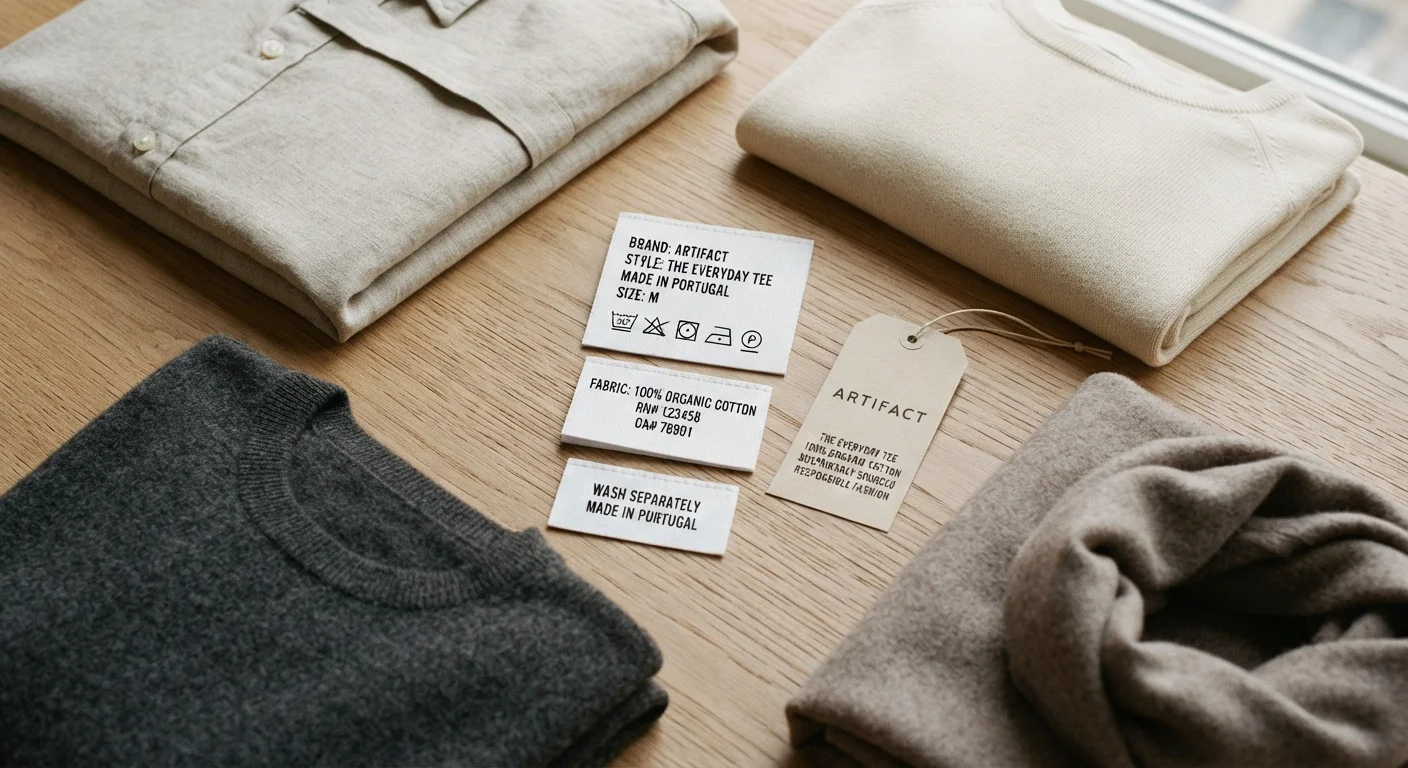
| FTC Labeling Requirement | Most U.S. clothing must disclose fiber content, country of origin, and care instructions (U.S. Federal Trade Commission, Care Labeling Rule) |
| Most Common Budget Fiber | Polyester — durable, wrinkle-resistant, low breathability |
| Best Natural Fiber for Basics | Cotton (especially in heavier fabric weights) |
| Fabric Weight Unit | GSM (grams per square meter) — higher GSM generally means sturdier fabric |
| Dominant Blend Fiber | The first fiber listed on the label makes up the largest percentage and drives overall feel |
| Viscose / Rayon Care Risk | Can stretch or distort when wet — check care label before purchasing |
Why the Fabric Tag Is the Most Important Part of Any Cheap Garment
That small, sometimes scratchy tag sewn into the seam isn't just a nuisance — it's the most honest thing a garment will ever tell you. Before the price tag, before the styling photos, the fiber content label reveals what you're actually buying: how it'll feel on your skin, how long it'll hold up, and what it'll cost you in care. For budget shoppers especially, ignoring this label is one of the fastest ways to waste money on clothes that fall apart after three washes.
The U.S. Federal Trade Commission requires most clothing sold in the United States to carry a label disclosing fiber content, country of origin, and care instructions. That regulation is your built-in consumer protection — use it. Once you know how to decode even the basics, you can make smarter choices at every price point. And smarter choices are how inexpensive clothes become genuine value, not disappointments.
Understanding cost-per-wear is the logical next step once you can evaluate fabric quality — because durability is the other half of that equation.
| FTC Labeling Requirement | Most U.S. clothing must disclose fiber content, country of origin, and care instructions (U.S. Federal Trade Commission, Care Labeling Rule) |
| Most Common Budget Fiber | Polyester — durable, wrinkle-resistant, low breathability |
| Best Natural Fiber for Basics | Cotton (especially in heavier fabric weights) |
| Fabric Weight Unit | GSM (grams per square meter) — higher GSM generally means sturdier fabric |
| Dominant Blend Fiber | The first fiber listed on the label makes up the largest percentage and drives overall feel |
| Viscose / Rayon Care Risk | Can stretch or distort when wet — check care label before purchasing |
The Most Common Fabrics in Budget Clothing — Decoded
Budget garments almost always use a short list of fibers, sometimes alone and sometimes blended. Knowing each one helps you set realistic expectations before you buy.
Polyester
The workhorse of affordable fashion. Polyester is durable, wrinkle-resistant, and holds color well — genuine advantages. The trade-off is breathability: it traps heat and can feel clammy in warm weather. Higher thread counts and tighter weaves improve the hand feel considerably, so texture matters when you're evaluating a polyester piece in person.
Cotton
Breathable, soft, and easy to care for, cotton is generally considered a positive sign on a budget label. The caveat: 100% cotton can shrink, wrinkle, and wear thin faster in low-GSM (grams per square meter) weights — common in ultra-cheap basics. A cotton-polyester blend (like a 60/40) often delivers better longevity while keeping breathability reasonable.
Viscose / Rayon
These terms refer to the same material: a semi-synthetic fiber made from wood pulp. Viscose drapes beautifully and mimics silk at a fraction of the price, which is why it appears in so many affordable blouses and dresses. Its weakness is moisture — it can stretch when wet, wrinkle easily, and often requires delicate or hand washing. Always check the care label before buying viscose.
Modal
A type of rayon made specifically from beech tree fibers, modal is softer and more durable than standard viscose. It's breathable and holds its shape better after washing, making it a genuinely good find in budget basics like T-shirts and underwear.
Acrylic
Acrylic is the budget stand-in for wool — it mimics the look and warmth at a much lower cost. It pills relatively quickly with friction, however, and doesn't breathe as well as natural fibers. A fabric shaver can extend the life of acrylic knitwear significantly.
GSM (Grams per Square Meter)
A measure of fabric weight. Heavier GSM typically signals a denser, more durable fabric. Lightweight basics in budget clothing often fall below 150 GSM, which can mean a shorter lifespan.
Viscose / Rayon
A semi-synthetic fiber derived from plant cellulose, most often wood pulp. It drapes softly and resembles silk but is prone to shrinking and stretching when wet.
Modal
A refined type of rayon made from beech tree fibers. Softer and more resilient than standard viscose, it performs better through repeated washing.
Spandex / Elastane / Lycra
Synthetic stretch fibers added in small percentages (usually 2–8%) to give a fabric elasticity and shape recovery. All three names refer to essentially the same material.
Pilling
Small fiber balls that form on fabric surfaces due to friction during wear or washing. Acrylic and low-quality cotton are especially prone to pilling over time.
Fiber Blend
A fabric made from two or more fiber types. Blends are common in budget clothing because they let manufacturers balance cost, comfort, and durability.
Fabric knowledge pairs directly with proper garment care — because even a solid fabric won't last if it's washed incorrectly.
Reading Blends and What the Percentages Actually Mean
Most budget garments list a blend — two or more fibers expressed as percentages. The dominant fiber (listed first and highest) determines the overall character of the fabric, while secondary fibers modify it. A 95% polyester / 5% spandex fabric behaves like polyester but with added stretch. A 55% linen / 45% cotton blend gets linen's texture and structure with cotton's softness and reduced wrinkling.
As a rule of thumb, the higher the percentage of a quality natural fiber (cotton, linen, wool, modal), the better the piece is likely to feel and breathe — though durability depends heavily on construction quality too. Seam finishing, stitching density, and fabric weight all factor into how long a garment holds up, even when the fiber content looks solid on paper.
~65%
Share of global textile fiber production that is synthetic
According to the Textile Exchange Preferred Fiber & Materials Report, synthetic fibers — primarily polyester — dominate global clothing production, making them the baseline fiber in most budget garments.
150+ GSM
Fabric weight threshold for more durable everyday basics
Industry standards in apparel manufacturing generally consider fabrics above 150 GSM more suitable for garments intended for repeated wear and washing.
When shopping secondhand, fiber content labels are just as useful — and often more so, since you can combine quality fabric with an even lower price. Our look at secondhand versus fast fashion value breaks down when each approach pays off. And if a garment has great fabric but an imperfect fit, a small alteration can make it look like it cost twice as much. Finally, the label is also your best defense against impulse buys that don't hold up — pausing to read it gives you a moment to evaluate rather than react to a price tag.