
Greens Powders and Superfood Blends: Category Realities Behind the Marketing

Key Takeaways
- Greens powders are dietary supplements, not replacements for whole fruits and vegetables.
- Most products use proprietary blends that make it difficult to assess individual ingredient doses.
- Third-party testing certifications are a meaningful quality signal worth looking for.
- Whole foods provide fiber, water content, and phytonutrients that powders cannot fully replicate.
- Consult a healthcare provider before adding any supplement to your routine, especially if you take medications.
Convenient way to increase plant-based micronutrient intake
On days when vegetable intake genuinely falls short, a greens powder can provide a modest dose of vitamins and minerals derived from plant sources. This is a practical benefit for people with very limited time for meal preparation.
May contain beneficial compounds not easily obtained individually
Some formulations include ingredients like spirulina, chlorella, or adaptogenic herbs that consumers might find difficult to source or prepare individually, consolidating several plant-based inputs into one product.
Third-party tested products offer a baseline quality assurance
Greens powders that carry independent testing certifications give consumers greater confidence that the product contains declared ingredients at stated levels and has been screened for certain contaminants.
Portable and shelf-stable compared to fresh produce
Unlike fresh vegetables, which spoil quickly, powdered supplements can be stored and transported easily, making them a practical option for travel or irregular schedules.
Cannot replicate the fiber content of whole vegetables
Most greens powders contain little to no dietary fiber, which is one of the most important components of whole plant foods for digestive health and satiety. This is a meaningful nutritional gap.
Proprietary blends obscure individual ingredient doses
Many products group ingredients into proprietary blends where only the combined weight is listed. This prevents consumers from knowing whether any single ingredient is present at a meaningful level.
Health claims are marketing statements, not FDA approvals
Phrases like "supports immunity" or "boosts energy" on supplement labels are permitted structure/function claims - they do not indicate the FDA has reviewed or confirmed the product's effectiveness for any purpose.
Evidence for most specific formulations is limited
Clinical research tends to focus on individual ingredients (e.g., spirulina, ashwagandha) rather than the multi-ingredient blends found in commercial greens powders. Extrapolating single-ingredient findings to a full blend is not scientifically straightforward.
Potential for interactions with medications
Ingredients like vitamin K (from leafy greens), certain herbal extracts, and high doses of antioxidants can interact with medications including blood thinners. This risk is rarely highlighted in product marketing.
Cost is high relative to whole-food alternatives
Many greens powder products carry a significant monthly cost. For most consumers, increasing actual vegetable consumption through whole foods would provide greater nutritional benefit at comparable or lower expense.
Our Verdict
Greens powders occupy a genuine - if limited - role in the supplement landscape. They may help some people bridge modest nutritional gaps on busy days, but they cannot substitute for a diet rich in whole vegetables and fruit. Their marketing frequently overstates the evidence, and ingredient transparency varies widely across the category.
Best suited to adults who already eat a reasonably balanced diet and are looking for a convenient nutritional safety net on days when vegetable intake falls short - not as a primary nutrition strategy.
What Greens Powders Actually Are
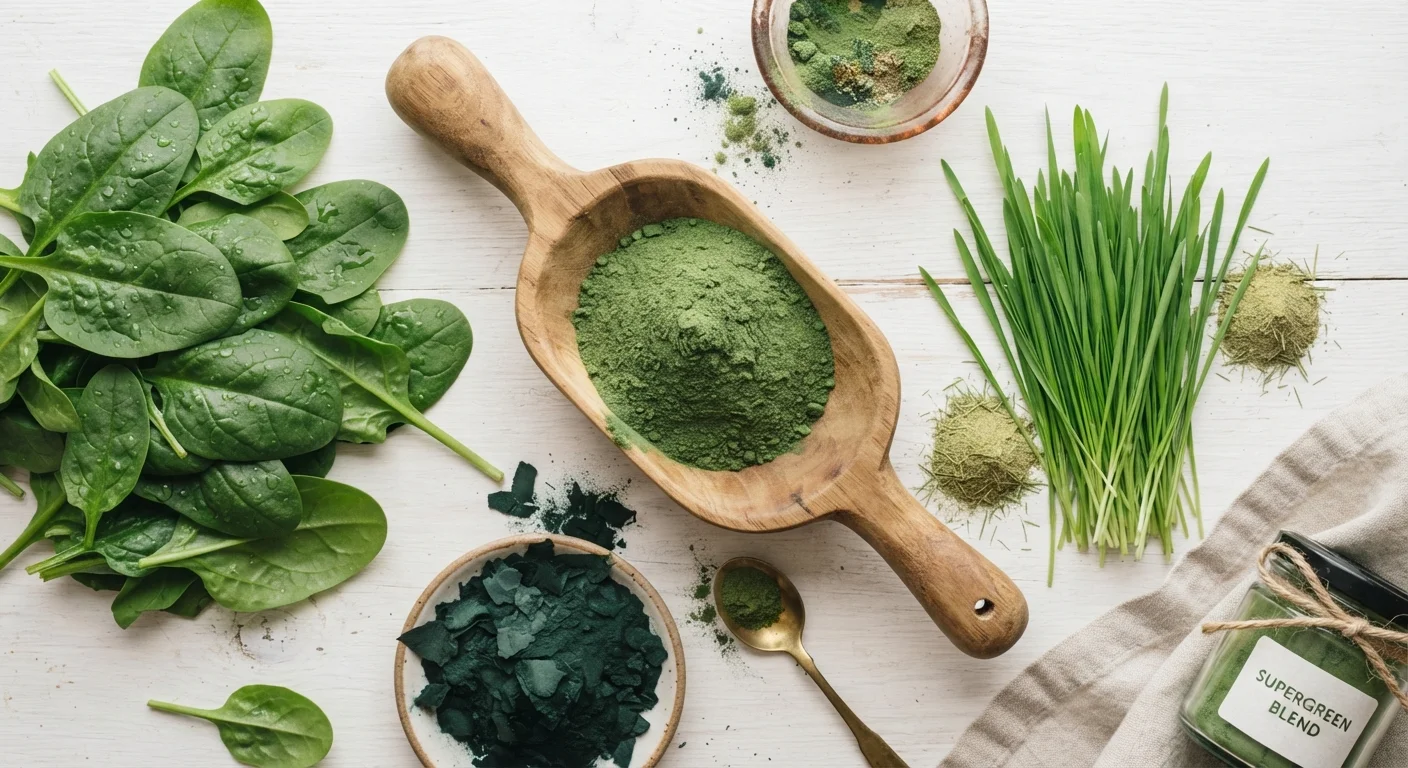
Greens powders are concentrated dietary supplements made by drying and grinding plant-based ingredients - commonly leafy greens like spinach and kale, algae such as spirulina and chlorella, cereal grasses like wheatgrass and barley grass, and various herbs, probiotics, or digestive enzymes. The resulting powder is typically mixed with water or added to smoothies.
As dietary supplements, they fall under the same regulatory framework as vitamins and protein powders in the United States. The Food and Drug Administration (FDA) does not evaluate most supplements for safety or effectiveness before they reach store shelves. Manufacturers are responsible for ensuring product safety, but pre-market approval is not required. For a fuller picture of how this category is governed, see how wellness products are regulated differently than most shoppers expect.
This regulatory context matters: the health claims printed on packaging - terms like "supports energy" or "promotes gut health" - are not FDA-approved. They are permitted marketing statements, not verified medical claims. Our piece on wellness claims on product labels that deserve a second look explains what these phrases actually signal.
The Real Advantages of This Category
Despite legitimate concerns, greens powders offer a few practical benefits worth acknowledging honestly.
Convenient way to increase plant-based micronutrient intake
On days when vegetable intake genuinely falls short, a greens powder can provide a modest dose of vitamins and minerals derived from plant sources. This is a practical benefit for people with very limited time for meal preparation.
May contain beneficial compounds not easily obtained individually
Some formulations include ingredients like spirulina, chlorella, or adaptogenic herbs that consumers might find difficult to source or prepare individually, consolidating several plant-based inputs into one product.
Third-party tested products offer a baseline quality assurance
Greens powders that carry independent testing certifications give consumers greater confidence that the product contains declared ingredients at stated levels and has been screened for certain contaminants.
Portable and shelf-stable compared to fresh produce
Unlike fresh vegetables, which spoil quickly, powdered supplements can be stored and transported easily, making them a practical option for travel or irregular schedules.
A key point to keep in mind: these advantages are situational and modest. They do not transform a poor diet into a healthy one, and they are not a substitute for the variety of whole foods that established nutrition guidance consistently recommends.
The Limitations the Marketing Downplays
The drawbacks of greens powders are real and frequently underemphasized in product marketing. Understanding them helps consumers set appropriate expectations.
Cannot replicate the fiber content of whole vegetables
Most greens powders contain little to no dietary fiber, which is one of the most important components of whole plant foods for digestive health and satiety. This is a meaningful nutritional gap.
Proprietary blends obscure individual ingredient doses
Many products group ingredients into proprietary blends where only the combined weight is listed. This prevents consumers from knowing whether any single ingredient is present at a meaningful level.
Health claims are marketing statements, not FDA approvals
Phrases like "supports immunity" or "boosts energy" on supplement labels are permitted structure/function claims - they do not indicate the FDA has reviewed or confirmed the product's effectiveness for any purpose.
Evidence for most specific formulations is limited
Clinical research tends to focus on individual ingredients (e.g., spirulina, ashwagandha) rather than the multi-ingredient blends found in commercial greens powders. Extrapolating single-ingredient findings to a full blend is not scientifically straightforward.
Potential for interactions with medications
Ingredients like vitamin K (from leafy greens), certain herbal extracts, and high doses of antioxidants can interact with medications including blood thinners. This risk is rarely highlighted in product marketing.
Cost is high relative to whole-food alternatives
Many greens powder products carry a significant monthly cost. For most consumers, increasing actual vegetable consumption through whole foods would provide greater nutritional benefit at comparable or lower expense.
One especially common issue is the use of proprietary blends - a labeling practice where multiple ingredients are grouped under a single listed amount. This makes it impossible to know whether any individual ingredient is present at a clinically relevant dose or merely a trace amount included for label appeal. This pattern is discussed in broader context in our article on nutrition claims that sound scientific but aren't.
A Note on "Superfood" as a Term
"Superfood" is a marketing term, not a scientific or regulatory category. No U.S. regulatory body defines or certifies foods or supplements as superfoods. While some ingredients commonly labeled this way - such as spirulina or blueberry extract - do have studied nutritional properties, the term itself carries no standardized meaning and should not be treated as a quality guarantee. Applying healthy skepticism to this label is always reasonable.
What to Look For When Evaluating Any Product in This Category
Rather than recommending any specific product, the following are general quality indicators that apply across the greens powder category:
- Third-party testing: Look for certifications from independent organizations (such as NSF International or USP) that verify a product contains what the label states and is free from certain contaminants.
- Transparent labeling: Products that disclose individual ingredient amounts - rather than hiding them behind a proprietary blend - allow for more informed evaluation.
- Ingredient simplicity: A shorter, clearly identified ingredient list is often easier to assess than a blend of 40+ ingredients with exotic names.
- Reasonable claims: Products making dramatic health promises warrant extra skepticism. For context on interpreting supplement categories more broadly, see our guide to dietary supplements decoded.
Price alone is not a reliable quality signal in this category. High cost does not guarantee superior formulation or better absorption. For general guidance on value-based comparison shopping, the price comparison hub offers practical frameworks.
1 in 10
U.S. adults meet vegetable intake recommendations
CDC data indicates that fewer than one in ten American adults consume the recommended daily amount of vegetables, which partly explains the appeal of supplement alternatives.
~$50B
U.S. dietary supplement market annual revenue
According to industry estimates, the U.S. dietary supplement market generates tens of billions of dollars annually, with greens and superfood blends among the faster-growing subcategories.
Greens Powders in Context: What Whole Foods Still Do Better
Greens powders cannot replicate everything a serving of whole vegetables provides. Whole vegetables contribute dietary fiber that supports digestive health and satiety - fiber that is substantially reduced or absent in most powdered products. They also deliver water content, which contributes to daily hydration. Perhaps most importantly, the complex matrix of phytonutrients in whole plants - interacting in ways that researchers are still studying - is difficult to reproduce in a concentrated supplement form.
Current dietary guidance from organizations including the USDA and CDC emphasizes whole fruits and vegetables as the foundation of a healthy eating pattern, not supplements. Greens powders are best understood as a potential complement to that foundation, not a shortcut around it.
If you are comparing this category to other powder-based supplements, our article on protein powders, collagen peptides, and amino acids offers a useful parallel look at how supplement categories serve distinct purposes. Similarly, the whole-food vs. synthetic vitamin distinction is relevant when evaluating how processing affects nutritional value.
This article is for general informational and educational purposes only and does not constitute medical or nutritional advice. Consult a qualified healthcare professional before starting any new supplement, particularly if you have an existing health condition or take prescription medications.