
Whole-Food Supplements vs. Synthetic Vitamins: What the Distinction Means in Practice

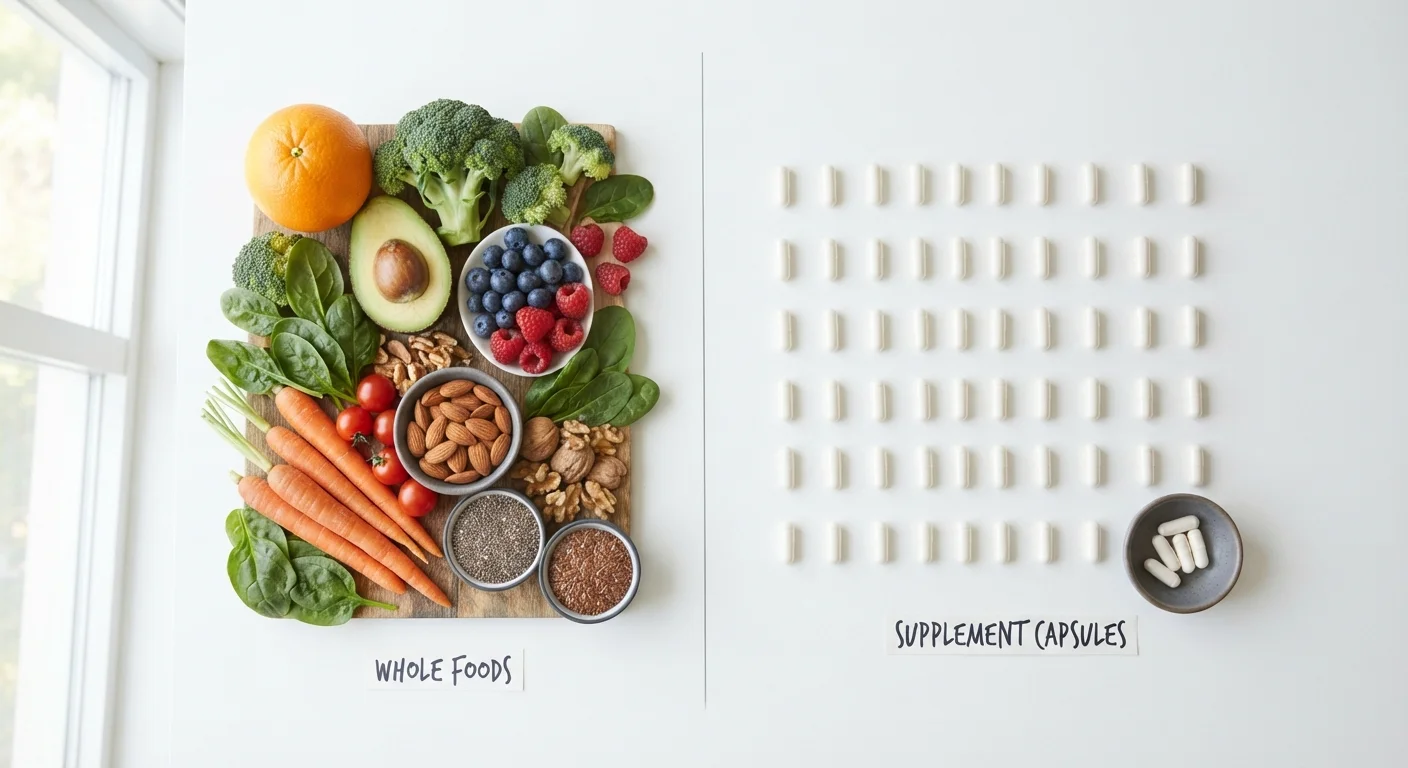
Key Takeaways
- The FDA does not legally define or regulate the term 'whole-food supplement,' so manufacturers apply it inconsistently.
- Many synthetic vitamins are chemically identical to their food-derived counterparts and are well-absorbed by the body.
- Some nutrients do have forms that differ in bioavailability - a genuine nuance worth understanding rather than a blanket rule.
- Neither category is universally superior; the research picture is mixed and context-dependent.
- Always consult a qualified healthcare professional before starting or changing any supplement routine.
Option A
Whole-Food Supplements
Nutrients sourced and concentrated from actual food ingredients.
Best for: Consumers who want supplements closely aligned with a food-first philosophy and are comfortable with lower, variable potency per dose.
Option B
Synthetic Vitamins
Lab-produced vitamins chemically identical - or nearly so - to naturally occurring forms.
Best for: Consumers who need predictable, standardized potency and who rely on clinical evidence for specific nutrient forms.
If you prefer nutrients delivered in a food-matrix context with cofactors naturally present
Whole-Food Supplements
Whole-food products retain the plant compounds surrounding a nutrient, which some researchers believe may support absorption - though clinical evidence for superior outcomes is limited.
If your healthcare provider has recommended a specific, clinically studied nutrient dose
Synthetic Vitamins
Synthetic forms deliver standardized potency per capsule, making it easier to meet precise targets recommended in clinical practice.
If you are navigating a diagnosed deficiency under medical supervision
Synthetic Vitamins
Most clinical research on correcting deficiencies has used standardized synthetic forms with well-documented dosage and absorption profiles.
If you want to complement an already balanced diet with a broad-spectrum product
Whole-Food Supplements
Whole-food multivitamins may provide naturally occurring phytonutrients alongside vitamins, though they often contain lower elemental nutrient amounts per serving.
What the Terms Actually Mean
Walk down any supplement aisle and you will see "whole-food," "food-based," or "food-grown" on dozens of labels alongside implied promises of natural superiority. Before comparing the two categories, it helps to understand what those words do - and do not - mean legally and scientifically.
Whole-food supplements are products where at least some vitamins or minerals are derived from, or cultured in, actual food or plant sources - think vitamin C extracted from acerola cherries or B vitamins grown into nutritional yeast. The idea is that the nutrient arrives packaged with cofactors (enzymes, phytonutrients, fiber) found naturally in that food.
Synthetic vitamins are compounds manufactured in a laboratory to match the chemical structure of a naturally occurring vitamin. The word "synthetic" can sound alarming, but it simply describes the production method - not an inferior or artificial end product. Ascorbic acid, the synthetic form of vitamin C, shares the same molecular structure as the form found in an orange.
Critically, the U.S. Food and Drug Administration (FDA) does not define or regulate the phrase "whole-food supplement." Manufacturers apply it voluntarily and with varying standards, which makes the label more of a marketing category than a regulated claim. For a broader look at how supplements fit into U.S. regulatory frameworks, see our guide on wellness product categories and their regulatory oversight.
Bioavailability: Where the Debate Gets Real
The strongest argument made for whole-food supplements centers on bioavailability - how well the body absorbs and uses a nutrient. Proponents suggest that food-matrix cofactors improve uptake compared with isolated synthetic compounds.
The evidence here is genuinely nuanced, not a simple win for either side:
- Some forms do differ. Folate is a well-documented example: naturally occurring food folate and synthetic folic acid are absorbed somewhat differently, with folic acid actually showing higher bioavailability in controlled studies - though both support normal red blood cell formation. Methylfolate, a third form, is often recommended for individuals with certain genetic variants that affect folate metabolism.
- Many forms are equivalent. For nutrients like vitamin C or most B vitamins, research has not consistently shown that food-derived versions outperform well-manufactured synthetic ones when the chemical structure is identical.
- Cofactor benefits are plausible but underresearched. The hypothesis that phytonutrients in a whole-food matrix enhance absorption is scientifically reasonable, but large, well-controlled human trials specifically comparing whole-food supplements to synthetic equivalents remain limited.
| Criterion | Whole-Food Supplements | Synthetic Vitamins |
|---|---|---|
| Nutrient source | Concentrated from plant or food sources | Manufactured in a laboratory |
| Chemical structure | Same as naturally occurring forms | Same as naturally occurring forms |
| Potency per serving | Often lower and more variable | Standardized and typically higher |
| Cofactors present | May include phytonutrients and enzymes | Usually isolated nutrient only |
| FDA regulatory definition | No official definition exists | No separate classification; same rules apply |
| Clinical research base | Limited direct comparisons | Extensive for most individual nutrients |
| Cost (general range) | Typically higher per dose | Typically lower per dose |
This complexity is worth keeping in mind when you encounter sweeping claims in either direction. For related nuance on how food processing affects nutrient content, our article on whole foods versus processed foods provides useful context.
Potency, Labeling, and Practical Gaps
One frequently overlooked practical difference involves dose per serving. Because whole-food supplements concentrate nutrients from plant sources, the elemental nutrient amount in each capsule is often lower than in a synthetic counterpart. A consumer taking a whole-food vitamin C product may be getting 60 mg from acerola per serving while a synthetic ascorbic acid tablet commonly delivers 500 mg or more.
Neither amount is inherently better - it depends on the individual's dietary baseline and health needs - but the discrepancy matters if someone is trying to meet a specific intake goal guided by a healthcare provider.
~80%
U.S. adults who have used dietary supplements
According to the Council for Responsible Nutrition's 2023 Consumer Survey, roughly 74-80% of U.S. adults report using dietary supplements, underscoring widespread consumer reliance on this product category.
No legal definition
Regulatory status of 'whole-food supplement' label
The FDA does not define or enforce the term 'whole-food supplement,' meaning any manufacturer can apply the label without meeting a standardized threshold.
Labeling also varies. Supplement labels are required to list the amount of each nutrient in standard units, but they are not required to specify whether the source is synthetic or food-derived unless the manufacturer chooses to highlight it. Third-party testing seals (such as those from NSF International or USP) can help verify that label claims match actual contents, regardless of whether a product is whole-food or synthetic.
Consumers interested in understanding similar marketing complexity in other supplement categories may find our overview of greens powders and superfood blends informative.
When Specific Nutrient Forms Matter Most
Certain populations may genuinely benefit from specific nutrient forms regardless of their source. For example, individuals with the MTHFR genetic variant may process folate differently, making the methylfolate form relevant. Pregnant individuals, older adults, and those with diagnosed deficiencies have distinct nutrient needs that warrant individualized guidance. If you fall into one of these groups, consult a qualified healthcare provider rather than relying on general label claims.
This article is for general informational and educational purposes only and is not a substitute for professional medical advice, diagnosis, or treatment. Speak with a qualified healthcare provider before starting, stopping, or changing any supplement routine.