

Key Takeaways
- 'Grain-free' eliminates cereal grains but often substitutes other starchy carbohydrate sources.
- 'Natural' has a partial AAFCO definition but is not equivalent to organic, safe, or nutritionally complete.
- Neither term is federally regulated with strict, uniform enforcement across all states.
- The FDA has investigated a possible link between grain-free diets and dilated cardiomyopathy in dogs - consult your vet.
- Ingredient lists and AAFCO nutritional adequacy statements are more reliable guides than front-of-bag claims.
Grain-Free & Natural (Pet Food Labels)
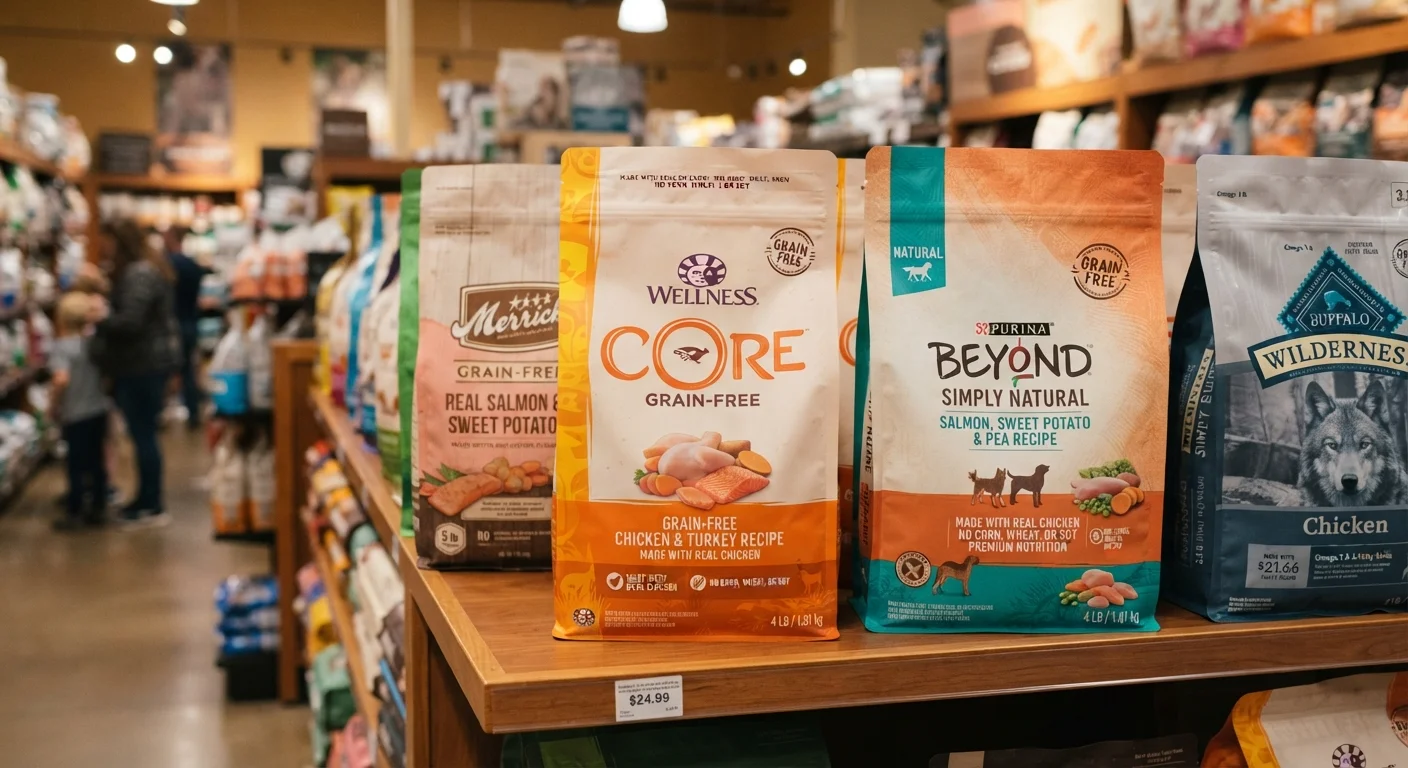
'Grain-free' on pet food means the product contains no corn, wheat, rice, or other cereal grains - but it may still contain high-starch ingredients like potatoes or peas. 'Natural' is a loosely defined term in pet food labeling that generally means ingredients derived from plant, animal, or mined sources without chemical synthesis - but it does not mean organic, pesticide-free, or nutritionally superior. Neither term is a quality guarantee.
In the U.S., the Association of American Feed Control Officials (AAFCO) provides a working definition for 'natural' in pet food, but enforcement varies by state. 'Grain-free' has no standardized regulatory definition from AAFCO or the FDA.
Why These Labels Dominate Pet Food Aisles
Walk down any pet food aisle and you'll notice two phrases appearing on bag after bag: grain-free and natural. They signal health and quality to many shoppers - and that's precisely why manufacturers use them. But before those terms influence your purchasing decisions, it helps to understand what they're actually required to mean, and what's left entirely to the manufacturer's discretion.
Pet food labeling in the U.S. sits in a regulatory gap. The FDA enforces safety standards, while the Association of American Feed Control Officials (AAFCO) publishes model guidelines that states may - but aren't required to - adopt. The result is a patchwork system where label claims carry different weight depending on the specific term used. For a broader look at how this plays out across product categories, see how different products face different regulatory standards.
0
Federal regulatory definitions for 'grain-free' in pet food
Neither AAFCO nor the FDA has established a standardized regulatory definition for the term 'grain-free' on pet food packaging.
50+
U.S. states with independent pet food labeling authority
Each state may independently adopt or modify AAFCO model regulations, creating inconsistent enforcement of label standards across the country.
~30%
Share of U.S. pet food sales attributed to premium/natural segment
Market research from multiple industry analysts indicates the 'natural' and premium pet food segment accounts for a significant and growing share of overall pet food retail sales.
What 'Grain-Free' Actually Requires
'Grain-free' is one of the most common claims on premium pet food - and one of the least regulated. AAFCO has no standardized definition for 'grain-free,' and neither does the FDA. In practice, a product labeled grain-free simply omits cereal grains: corn, wheat, barley, oats, rice, and similar ingredients.
What that label does not restrict is the use of other carbohydrate sources. Many grain-free formulas replace grains with potatoes, sweet potatoes, peas, lentils, or chickpeas - ingredients that can carry a comparable or higher glycemic load than some grains. For pet owners trying to reduce starch, this substitution often goes unnoticed.
There's also an active area of scientific scrutiny worth knowing about. The FDA launched an investigation into a potential association between grain-free diets - particularly those high in legumes - and dilated cardiomyopathy (DCM), a serious heart condition, in dogs. As of the most recent public updates, the investigation is ongoing and a definitive causal relationship has not been established. If you have concerns about your dog's diet and heart health, consult your veterinarian.
Check Ingredients, Not Just the Claim
If you're choosing grain-free food to manage a specific dietary concern, scan the full ingredient list for alternative starch sources like peas, lentils, and potatoes. These substitutes are common in grain-free formulas and may be relevant depending on your pet's health needs. Your veterinarian can help you evaluate whether a grain-free diet is appropriate.
What 'Natural' Is - and Isn't - Required to Mean
Unlike 'grain-free,' the term 'natural' does have a working definition in AAFCO's model regulations. AAFCO defines natural as derived solely from plant, animal, or mined (mineral) sources - either in an unprocessed state or processed by physical, thermal, or fermentation methods. Chemical synthesis is the key disqualifier.
However, this definition has meaningful gaps. A product can carry a 'natural' label while still containing chemically synthesized vitamins and minerals, provided the label includes a disclosure phrase such as 'with added vitamins and minerals.' That's a detail most consumers miss.
'Natural' also does not mean:
- Certified organic or grown without pesticides
- Free of all processing
- Nutritionally complete or superior
- Safer than non-natural alternatives
This mirrors a broader pattern in consumer product labeling. The assumption that 'natural' means safe is one of the most persistent misconceptions in shopping - and it applies directly to pet food. Similarly, food label terms that seem meaningful but require a closer look often mislead shoppers across grocery and pet categories alike.
AAFCO Guidelines Are Not Federal Law
AAFCO is a non-governmental organization that publishes model guidelines, not binding federal regulations. States choose whether and how to adopt them, which means the same label claim can face different levels of scrutiny depending on where a product is sold. Always verify what standards apply in your state if you have specific concerns about a label claim.
What to Look at Instead
Front-of-bag marketing exists to attract attention. For actual nutritional information, the back of the bag is where the reliable data lives. Two elements are worth prioritizing:
- The AAFCO nutritional adequacy statement: This tells you whether the food meets established nutrient profiles for a specific life stage (puppy/kitten, adult, senior). Look for phrases like 'formulated to meet' or 'animal feeding tests.' This is a meaningful benchmark that front-label claims cannot replicate.
- The ingredient list: Ingredients are listed by pre-cooking weight, so a named protein source near the top is a positive signal. Reading a pet food label in full - including the guaranteed analysis panel - gives you a much clearer picture than any single marketing claim.
If your pet has a specific health condition, food allergy, or dietary restriction, a veterinarian or board-certified veterinary nutritionist is the right resource for guidance - not the front of a bag.