

Key Takeaways
- Ingredients are listed by pre-cooking weight, which significantly affects how you interpret protein rankings.
- The guaranteed analysis panel shows minimums and maximums, not exact nutrient amounts.
- Marketing terms like 'natural' and 'premium' carry limited regulatory weight on pet food labels.
- Ingredient splitting can push lower-quality components further down the list than their total quantity warrants.
- AAFCO nutritional adequacy statements indicate whether a food was tested or only formulated to meet standards.
What you will need
Why Pet Food Labels Require a Different Reading Approach
Pet food in the United States is regulated at both federal and state levels, with the AAFCO providing the model definitions and nutrient standards that most states adopt. The result is a labeling system that contains real, enforceable information - but also significant room for marketing language that sounds meaningful without being regulated.
Reading a pet food label effectively means separating the regulated sections - the ingredients list, guaranteed analysis, and nutritional adequacy statement - from the front-of-pack claims that exist primarily to attract attention. If you've ever worked through reading a human nutrition facts label, you'll recognize a similar dynamic: the useful data is almost always on the back or side panel.
The stakes matter. Pet food is a recurring household cost, and choosing based on packaging claims rather than label facts can mean paying more for a formula that doesn't serve your animal's needs - or missing a well-formulated option at a lower price point.
What you will need
Tools You'll Need
You don't need much to evaluate a pet food label, but a few resources sharpen your analysis considerably.
AAFCO Official Publication or Website
Provides the regulatory definitions for ingredient terms, nutrient profiles, and nutritional adequacy claim language used on U.S. pet food labels.
Dry-Matter Basis Calculator
Converts guaranteed analysis figures from an as-fed basis to a moisture-free basis so you can accurately compare kibble and wet foods.
Veterinary Nutritionist Consultation
Offers personalized guidance when a pet has a health condition, allergy, or life-stage requirement that standard label-reading cannot address.
Step-by-Step: How to Read the Label
Locate and read the AAFCO nutritional adequacy statement
Before you look at a single ingredient, find the statement that reads something like: '[Product] is formulated to meet the nutritional levels established by the AAFCO [Dog/Cat] Food Nutrient Profiles for [life stage].' This line tells you two critical things: which species and life stage the food is designed for, and how compliance was established.
A food that says 'feeding trials' has been fed to actual animals and monitored. One that says 'formulated to meet' was calculated on paper. Both can be adequate, but the distinction is worth knowing.
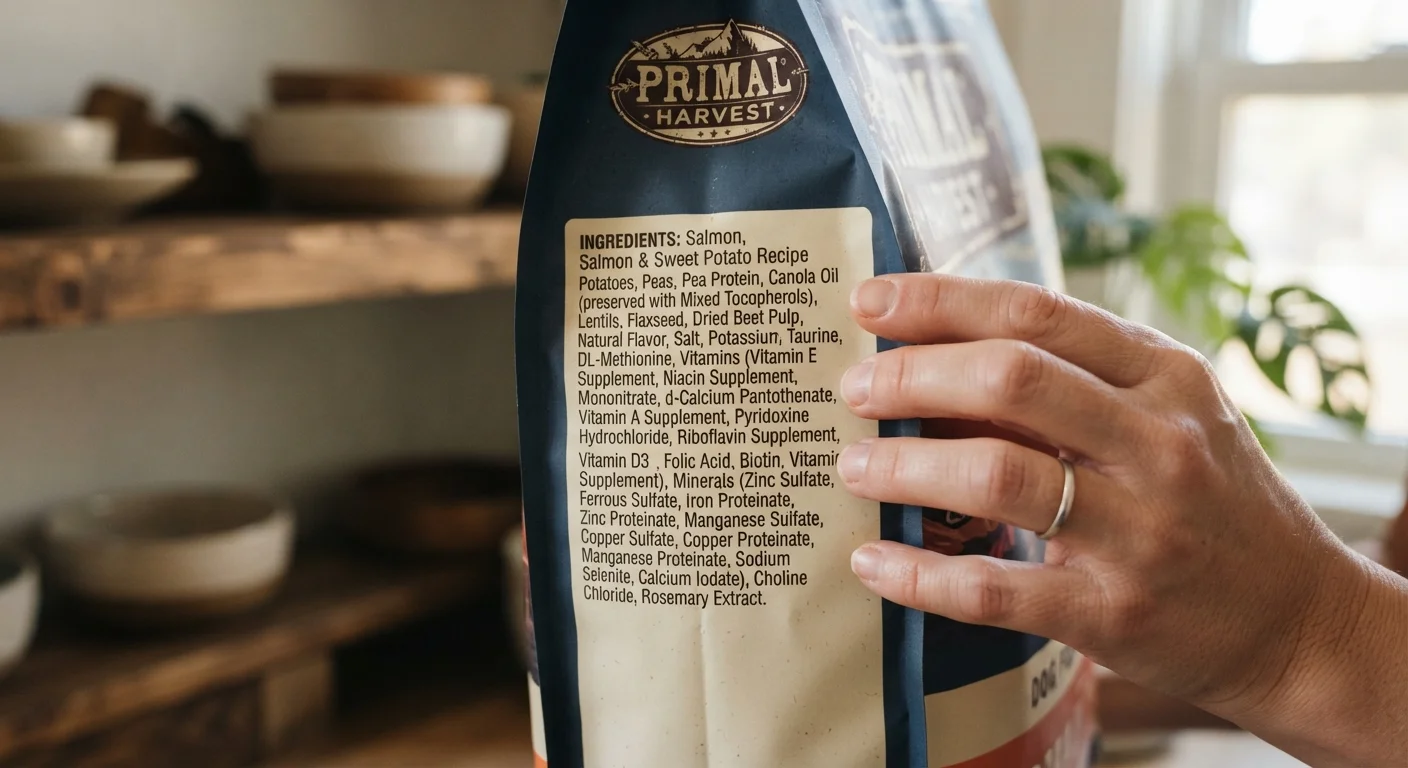
Read the ingredients list from top to bottom - with context
Ingredients are listed in descending order by pre-cooking weight, not by the amount of nutrition they contribute after processing. This matters enormously for meat ingredients. Fresh chicken, for example, is roughly 70-75% water. After cooking, it shrinks dramatically and may contribute less protein than a dry ingredient listed below it, like chicken meal.
Chicken meal is already dehydrated and concentrated - it can contain up to 65% protein by weight. Neither is inherently better or worse; they are simply different forms. Understanding this prevents you from dismissing a food because 'meal' appears early in the list.
Identify and flag ingredient splitting
Ingredient splitting is the practice of listing a single ingredient under multiple names to push it further down the list. For example, a formula might list: chicken, brown rice, white rice, rice flour, rice bran. Individually, each rice fraction ranks below chicken - but combined, rice could outweigh chicken in the final product.
Watch for this pattern with grains, starches, and sugars. It doesn't automatically make a food poor quality, but it means the effective ranking of those ingredients is higher than it appears.
Interpret the guaranteed analysis panel
The guaranteed analysis lists four values required by U.S. regulation: minimum crude protein, minimum crude fat, maximum crude fiber, and maximum moisture. Manufacturers may voluntarily add others. Key points:
- Minimums mean the product contains at least that percentage - the actual amount could be higher.
- Maximums mean the product contains no more than that percentage.
- These figures are measured on an as-fed basis, meaning moisture is included. Wet foods will show lower protein percentages not because they have less protein, but because they contain more water.
To compare foods fairly across formats, you need to convert to a dry-matter basis. See the tip callout for how to approach that.
Evaluate specific ingredients for your pet's needs
Once you understand structure and order, look at what is actually in the formula relative to your pet's individual situation. A few considerations:
- Named protein sources ('chicken,' 'salmon,' 'beef') are more traceable than generic terms ('meat,' 'poultry') - useful if your pet has a suspected food sensitivity.
- By-products are regulated ingredients that include organ meats and are nutritionally dense; the term itself does not indicate low quality.
- Preservatives: naturally derived options include mixed tocopherols (vitamin E) and rosemary extract; synthetic ones such as BHA, BHT, and ethoxyquin are approved at regulated levels but some owners prefer to avoid them.
For pets with diagnosed conditions, a veterinary nutritionist's input is more reliable than any label analysis. This is general information, not a substitute for professional veterinary guidance.
Dry-Matter Basis Gives a Truer Comparison
When comparing a dry kibble to a canned food, moisture content makes the guaranteed analysis numbers misleading at face value. Ask your vet or use an online dry-matter calculator to convert both foods to a moisture-free basis before comparing protein or fat percentages. This is especially relevant if you're weighing cost-per-nutrient across formats - a topic covered in our dry vs. wet food comparison.
Always Verify Life-Stage Appropriateness
A food labeled 'for all life stages' must meet the highest nutrient thresholds - those for growth and reproduction - which may not be ideal for every adult or senior pet. Puppies, kittens, pregnant, or nursing animals have distinct needs. Consult your veterinarian before switching foods, particularly for young, elderly, or health-compromised pets.
Common Marketing Terms and What They Actually Mean
Once you've worked through the regulated sections, you'll likely still encounter front-of-pack language that sounds authoritative but isn't governed by the same rules. A few examples:
- 'Natural' has an AAFCO definition - it generally excludes chemically synthesized ingredients - but it does not imply the food is nutritionally superior or minimally processed.
- 'Holistic,' 'premium,' and 'human-grade' have no regulatory definition in U.S. pet food labeling and can be used freely by any manufacturer.
- 'With real chicken' - under AAFCO's 'with' rule, a product using this phrasing need only contain 3% of that named ingredient.
For a deeper look at how these terms are defined - or left undefined - see our article on what 'grain-free' and 'natural' actually mean on pet food packaging. The same pattern of loosely regulated language shows up across consumer products; food label terms that seem meaningful but require a closer look covers the human food side of this issue.
Don't Rely Solely on Front-of-Pack Claims
Terms like 'holistic,' 'premium,' and 'human-grade' are not defined or enforced by U.S. federal pet food regulations. They are marketing language. Always flip the bag and evaluate the ingredients list and guaranteed analysis panel directly. Our article on what 'grain-free' and 'natural' really mean explains where regulatory definitions begin and end.
This article provides general educational information about pet food labeling and is not a substitute for personalized veterinary advice. Consult a licensed veterinarian or board-certified veterinary nutritionist for guidance specific to your pet's health and dietary needs.