

Key Takeaways
- Dressing to flatter focuses on visual proportion and fit; dressing to express prioritizes communicating identity and mood.
- Neither approach is superior — the most satisfying wardrobes typically blend both intentionally.
- Traditional flattery rules (like 'dress for your body type') are guidelines, not laws, and carry cultural baggage worth examining.
- Self-expression doesn't require a big budget — it requires self-awareness and deliberate choices.
- Deciding which goal matters more in a given moment helps you shop and get dressed with far less second-guessing.
Our Verdict
Flattery and expression are two distinct style goals, and most people unconsciously toggle between them without realizing it. Once you can name which mode you're operating in, getting dressed — and spending money on clothes — becomes far more intentional and satisfying. The strongest personal style emerges when you decide, consciously, which goal leads and which one supports.
| Best for | Recommended |
|---|---|
| Those who want to feel put-together and confident in professional or social settings | Dressing to Flatter |
| Those building a wardrobe that reflects who they actually are | Dressing to Express |
| Those who want a sustainable, budget-conscious approach to personal style | A deliberate blend of both |
Two Goals, One Closet
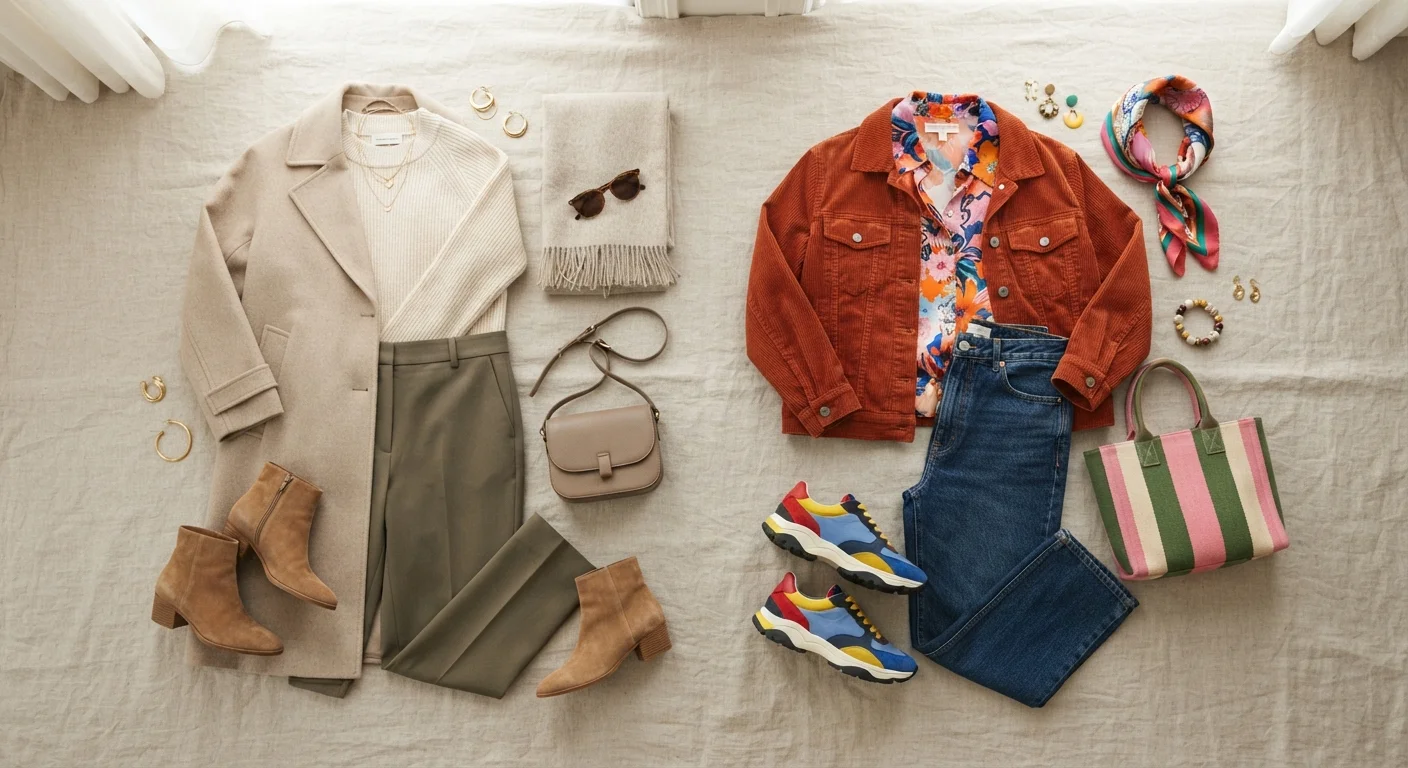
Style advice has a default setting: wear what flatters you. It sounds helpful, but it quietly assumes that the entire point of getting dressed is to look a certain way to other people. Dressing to express yourself operates on a completely different premise — that clothes are a language you use to communicate who you are, regardless of whether they minimize your hips or elongate your torso.
These two goals aren't enemies, but they're not the same thing either. Conflating them leads to the frustrating loop of buying pieces that are technically flattering but feel hollow, or loving an outfit in theory but feeling vaguely self-conscious wearing it out. Understanding the actual distinction is one of the most practical, cost-saving things you can do for your wardrobe. For a broader framework on building style with intention, check out this end-to-end personal style guide.
What 'Flattering' Actually Means
At its core, dressing to flatter is about visual proportion — using silhouette, color, and fit to create a particular effect on the eye. Think waist definition, vertical lines to create length, or dark colors to recede certain areas. These are real optical principles, and when applied on your own terms, they can genuinely boost confidence.
The catch? Traditional flattery advice has historically been prescriptive in ways that carry cultural weight. 'Dress for your body type' frameworks often assume everyone is trying to approximate a single silhouette. You're not obligated to follow those rules. The principles professional stylists actually use tend to be more nuanced — centered on fit and proportion rather than rigid body-type categories.
| Dressing to Flatter | Dressing to Express | |
|---|---|---|
| Primary goal | Optimize visual proportion and fit | Communicate identity, mood, or values |
| Measures success by | How the outfit looks to others | How the outfit feels to the wearer |
| Core tools | Silhouette, color theory, tailoring | Aesthetic vocabulary, intentional curation |
| Common pitfall | Following rules that don't serve you | Impulse buying without coherence |
| Budget impact | Fit corrections can add cost | Trend-chasing can inflate spending |
| Best used when | Confidence or polish is the priority | Authenticity or mood is the priority |
Used thoughtfully, flattery principles are tools. Used as rules handed down by someone else, they're just noise.
What Self-Expression Actually Requires
Dressing to express yourself means choosing clothes that feel like an accurate — or aspirational — reflection of your identity, values, or mood. This might look like a maximalist mixing bold prints, a minimalist in monochromatic neutrals, or someone who rotates between both depending on the day. None of these approaches requires a luxury budget.
What expression does require is self-knowledge. Without a clear sense of what you're trying to say, expressive dressing easily drifts into impulse buying — picking up whatever feels exciting in the moment but never quite cohering into an actual wardrobe. That's where grounding your inspiration in your real daily life becomes essential. Pinterest boards are starting points, not blueprints.
Test Your Own Default Setting
Next time you hesitate on a piece, notice what the hesitation is about. Is it 'this doesn't fit right' (a flattery concern) or 'this doesn't feel like me' (an expression concern)? Those are different problems with different solutions. Getting clear on the distinction helps you shop more deliberately and second-guess yourself far less.
Expression is also where trends can play a useful — or disruptive — role. A trend might offer you a new vocabulary to try on, or it might simply cost you money without adding anything authentic. Understanding when trends work for you helps you engage with them on your own terms rather than reflexively.
How to Blend Both Without Losing Either
The most wearable wardrobes tend to use flattery as a filter and expression as the engine. That means starting from what you want to communicate — your aesthetic, your vibe, your values — and then applying fit and proportion principles to make that vision work on your actual body, in your actual life.
A few practical ways to do this:
- Anchor expressive pieces with fit. A bold statement piece lands harder when it fits well. Tailoring or size-swapping thrifted finds is one of the highest-ROI moves in budget fashion.
- Question the 'flattering' reflex. When you hesitate on a piece because it isn't 'flattering,' ask yourself — flattering by whose standard? If you love it, that's data worth weighing.
- Use the occasion as a calibration tool. Some contexts call for more flattery-conscious choices; others free you up to lean fully expressive. Knowing which mode fits which moment reduces friction.
For a deeper look at two structured ways to organize an intentional wardrobe, see signature style vs. capsule wardrobe. Either approach works better once you've settled this foundational question first.