

Key Takeaways
- 5G speeds vary dramatically depending on which frequency band your carrier deploys in your area.
- In most everyday tasks — browsing, streaming, messaging — 4G LTE is often fast enough to feel identical.
- mmWave 5G offers peak speeds but has very limited range and building penetration.
- A 5G phone doesn't automatically mean you'll experience 5G speeds everywhere you go.
- Rural and suburban users may see minimal real-world benefit from 5G for several more years.
The Gap Between 5G Marketing and 5G Reality
Walk into any carrier store or scroll through phone listings online and you'll see 5G featured as prominently as the camera or battery life. But unlike megapixel counts or screen resolution, 5G is a network technology — which means the experience you actually get depends less on the phone in your hand and more on the infrastructure in your neighborhood.
5G comes in three distinct frequency bands, and they behave very differently. Low-band 5G (below 1 GHz) covers wide areas and penetrates buildings well, but its speeds are only modestly faster than solid 4G LTE. Mid-band 5G (around 2.5–4 GHz) offers a meaningful speed and latency improvement and is increasingly the backbone of US carrier deployments. High-band 5G, known as mmWave (millimeter wave), can deliver staggering theoretical speeds — but its signals travel only short distances and are blocked by walls, glass, and even heavy rain.
Understanding which band is active near you is the single most important factor in knowing whether 5G will feel different in your daily life. For a broader look at how network specs connect to real phone performance, see our guide to smartphone specs.
Myth
If my phone says 5G in the status bar, I'm getting dramatically faster internet.
Fact
The 5G indicator only confirms you're connected to a 5G network — it says nothing about which band or how fast that connection actually is.
Carriers use the same 5G icon regardless of whether you're on slow low-band 5G or fast mid-band 5G. Low-band connections may deliver speeds only 20–30% faster than 4G LTE, while mid-band can be several times quicker. The icon alone is not a reliable indicator of performance.
Myth
5G is available everywhere across the US, just like 4G.
Fact
5G coverage maps are expanding, but meaningful mid-band and mmWave 5G remains concentrated in specific urban areas and venues.
Carriers have blanketed large geographic areas with low-band 5G signals, which allows them to claim broad coverage. However, the faster mid-band and mmWave tiers that deliver headline speeds are still largely limited to dense metro areas, select transit corridors, and specific venues. Rural coverage on high-performing 5G bands remains limited.
Myth
A 5G phone will have noticeably better battery life than a 4G phone.
Fact
5G modems can actually draw more power than 4G in weak-signal areas, potentially reducing battery life.
In zones with strong 5G coverage, modern 5G chips are reasonably efficient. But in fringe-coverage areas, the phone repeatedly searches for or maintains a 5G signal, increasing power draw. This is one reason some users in low-coverage areas choose to manually set their phone to LTE-only mode.
Myth
You need a 5G phone to be future-proof for the next several years.
Fact
4G LTE networks are expected to remain operational and well-supported for many years, and 5G's practical advantage depends heavily on your location.
Carriers have significant financial and infrastructure reasons to maintain 4G LTE alongside 5G for the foreseeable future. If you live in an area where 5G coverage is thin or low-band only, a 4G-capable device will deliver a virtually identical experience today — and likely for years to come. For a realistic look at how long phones stay useful, see our article on smartphone lifespan and durability.
Myth
mmWave 5G will be available indoors everywhere very soon.
Fact
mmWave signals struggle to pass through walls and windows, making reliable indoor coverage a persistent technical challenge.
mmWave frequencies carry enormous bandwidth but are physically limited by their inability to penetrate solid materials. Deploying mmWave indoors would require dense networks of small cells inside every building — an enormous infrastructure investment. Most indoor 5G coverage relies on low- or mid-band signals, not mmWave. The comparison to Wi-Fi 6E's indoor range challenges is instructive; see our piece on Wi-Fi 6E's 6 GHz limitations for a parallel discussion.
When 5G Makes a Difference — and When It Simply Doesn't
There are genuine use cases where 5G's capabilities translate into a noticeably better experience. Downloading a large app or software update in a crowded stadium, for example, is where mid-band or mmWave 5G can feel dramatically faster than 4G. Video calls and cloud gaming on a strong 5G connection also benefit from lower latency — the delay between sending and receiving data.
But for the most common smartphone tasks — checking social media, streaming music, navigating with maps, sending messages — the speed gap between 4G LTE and low-band 5G is functionally invisible. A well-maintained 4G LTE connection delivers more than enough throughput for HD video streaming or voice calls. The bottleneck in those moments is rarely your cellular connection.
~72%
US 5G connections on low-band spectrum
Industry analyses have consistently found that the majority of US 5G connections occur on low-band frequencies, which offer speeds only modestly above 4G LTE.
<500m
Typical mmWave 5G signal range outdoors
mmWave base stations generally serve a radius of less than 500 meters under ideal outdoor conditions, with significantly shorter range when obstacles are present.
Geography matters enormously. Dense urban environments with active mid-band or mmWave deployments are where 5G pays off most clearly. Suburban and rural users are largely served by low-band 5G today, meaning their practical experience is closer to 4G than the marketing imagery suggests. If you're deciding between phone options and wondering how carrier relationships affect your network access, our article on buying unlocked vs. carrier phones covers what compatibility actually means for network performance.
Don't Rely Solely on Coverage Maps
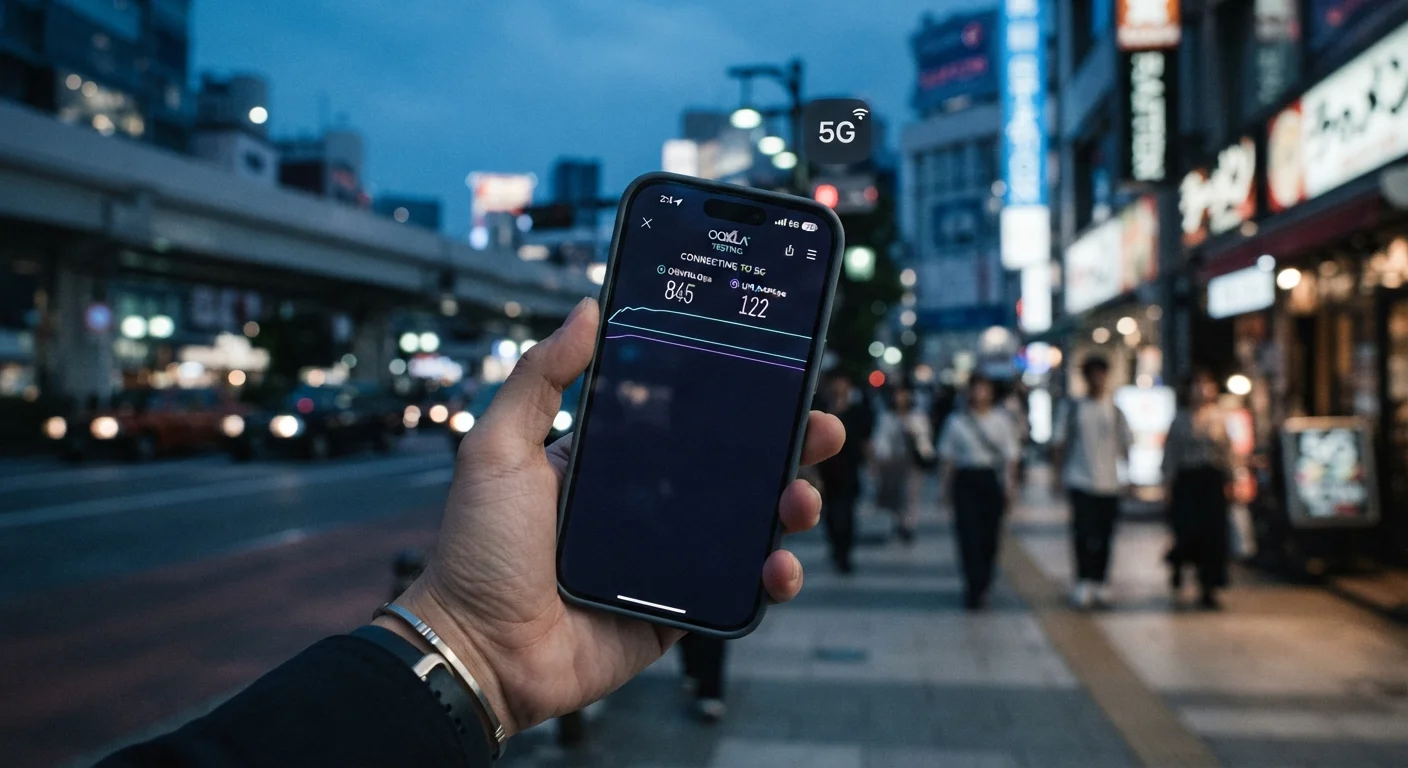
Carrier coverage maps indicate where a signal is theoretically available, not where you'll consistently get strong 5G performance. Building density, terrain, and local network congestion all affect real-world speeds in ways maps don't capture. If 5G performance is important to your decision, look for independent speed-test data for your specific city or neighborhood.
It's also worth noting that 5G radios can consume more battery than 4G in areas with weak 5G coverage, as the phone works harder to maintain a connection. Some devices allow users to switch between network modes in settings — a useful option if you're in a low-coverage area and want to preserve battery life.