

Key Takeaways
- A percentage-off tag only means savings if the original price was fair and accurate.
- Clearance items are not always the cheapest option once you factor in alternatives.
- Sale timing strategies like 'waiting for a bigger discount' can backfire without price history data.
- Total cost — including shipping, fees, and return policies — determines actual value.
- Comparing prices side-by-side before committing is the single most reliable shopping habit.
Why Sale Price Myths Persist
Sale pricing is one of retail's most powerful psychological levers — and that power depends partly on shoppers not questioning it. Phrases like '50% off' or 'lowest price of the season' trigger an automatic sense of urgency and value that bypasses the kind of side-by-side comparison that would reveal whether the claim holds up. The result is a set of widespread beliefs about discounts that feel intuitive but regularly fail under scrutiny.
This isn't about distrust of every retailer. Most discounts represent genuine price reductions. The problem is that not all of them do, and without a consistent habit of verification, it's difficult to tell the difference at the moment of purchase. The myths below cover the most common mental shortcuts that cost shoppers money — and what to do instead.
Myth
A 50% off tag automatically means you're getting a great deal.
Fact
The discount percentage only matters relative to a fair baseline price — and that baseline isn't always what it appears.
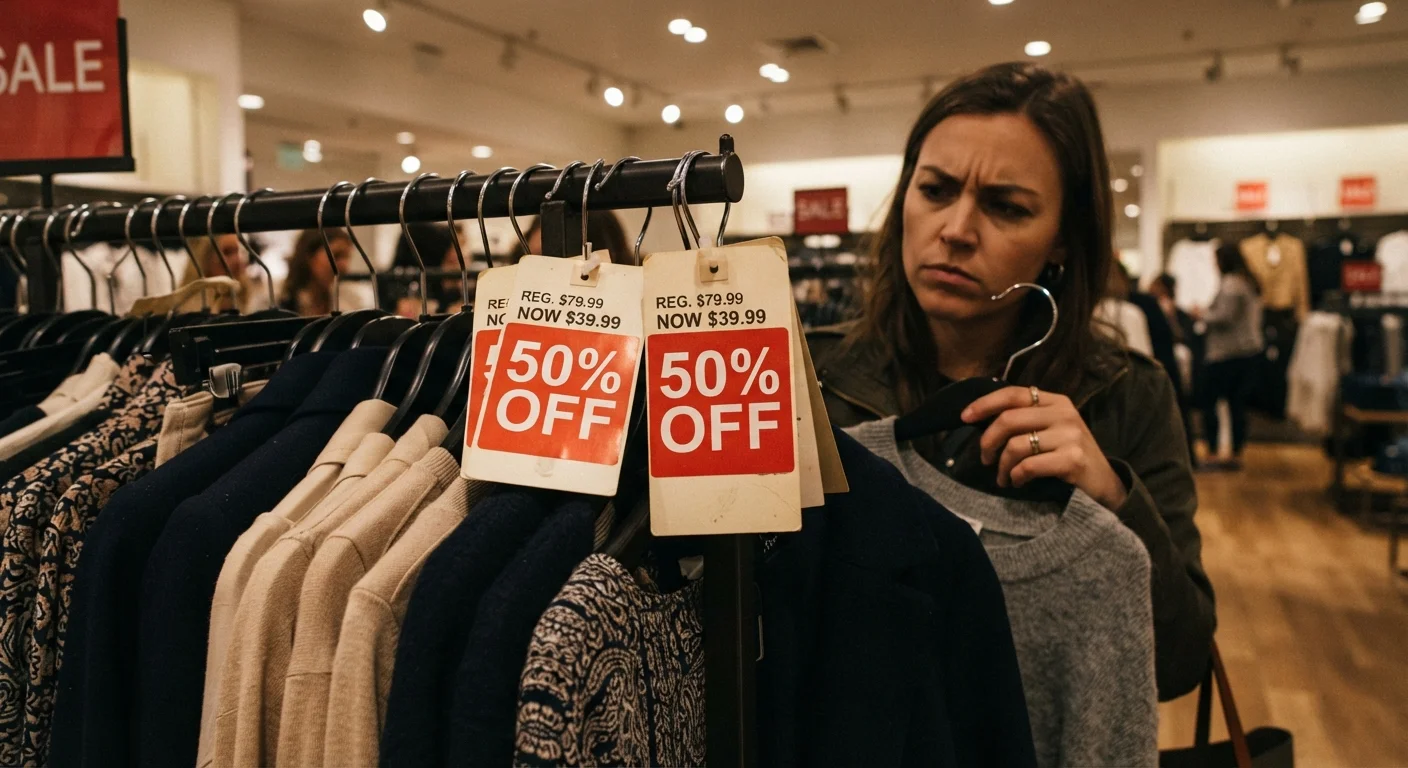
Percentage discounts are calculated against a reference price, often labeled 'original' or 'regular.' If that reference price was inflated — set high specifically to make the markdown look dramatic — the actual savings can be minimal. This practice, sometimes called reference price inflation, is well-documented in consumer pricing research. A 50% discount off an artificially high price may leave you paying more than you would at a competing retailer's everyday price. Always cross-check the discounted price against at least two other current sources before concluding the deal is real. See how to verify whether a price has actually dropped for practical methods.
Myth
Clearance items are always the cheapest way to buy something.
Fact
Clearance pricing beats standard retail, but it doesn't automatically beat every other channel or format.
Clearance sections move end-of-cycle inventory, which does produce genuine markdowns — but 'cheaper than full price here' is not the same as 'cheapest available.' An item on clearance at one retailer may still cost more than the same or equivalent product at a warehouse club, a competing store's regular price, or a certified refurbished channel. Clearance also frequently involves final-sale or restricted return policies, which shift financial risk to the buyer if the product is defective or wrong-sized. Understanding how each discount type actually works helps you evaluate whether clearance is truly the better option in any given situation.
Myth
Waiting longer always means a bigger discount.
Fact
Prices don't follow a simple downward slope — they fluctuate, and waiting can mean missing a genuine low point.
Many shoppers assume that holding out will eventually yield a better price, but retail pricing is dynamic. Prices rise and fall based on inventory levels, competitor pricing, demand signals, and promotional calendars. An item marked down 30% today may return to full price tomorrow and only reach 30% again months later — if ever. Without access to price history data for a specific product at a specific retailer, 'waiting for a better deal' is a guess, not a strategy. Understanding retailer sale calendars gives you a more reliable framework than indefinite waiting.
Myth
The lowest sticker price is always the lowest total cost.
Fact
Shipping fees, return restrictions, and membership requirements can flip which option is actually cheaper.
Two identical items priced at $45 and $52 are not a straightforward $7 difference if the $45 option carries a $9.99 shipping fee, a restocking penalty on returns, or requires a paid membership to access. Total cost of ownership — the full amount you spend to get and potentially return a product — is the only meaningful comparison metric. Hidden costs that make a lower price more expensive outlines the specific charges worth calculating before you commit.
Myth
Sale prices during major retail events are always the year's lowest.
Fact
Many items reach equivalent or lower prices at other points in the calendar year.
High-profile retail events create strong consumer expectations of record-low prices, but analysis of historical pricing data across product categories regularly shows that sale-event prices are not always the annual low for a given item. Some categories — certain electronics, for instance — do see category-wide discounts during major events. Others, including many apparel and home goods items, hit comparable or lower prices during less-promoted end-of-season clearance periods. Checking price history before a major sale event, rather than after, puts you in a better position to recognize whether an event-day price is genuinely notable.
Building a Comparison Habit That Actually Works
The antidote to sale price myths isn't skepticism for its own sake — it's a repeatable process. Before committing to any purchase framed around a discount, three questions do most of the work:
- What is this item's actual price history? Price-tracking tools log historical data for many online products, making it straightforward to see whether today's price is a genuine low or a routine level.
- What does the same or equivalent item cost elsewhere right now? A quick cross-retailer check closes the gap between 'on sale here' and 'cheapest available.' See the price comparison checklist for a structured way to do this efficiently.
- What is the true total cost? Add shipping, factor in return policy risk, and note any membership requirements before treating sticker prices as comparable.
These habits apply across every category. The same logic that protects you from an inflated fashion markdown also applies to electronics, groceries, and home goods. For a broader look at how spending patterns quietly erode savings, sale traps in fashion budgets and grocery budget myths both show the same dynamics at work in different aisles.
Don't Let Urgency Override Research
Flash sale countdown timers and 'limited quantities' messaging are designed to compress your decision window. Purchasing under artificial time pressure without comparing prices first is one of the most documented ways shoppers overpay. If you cannot verify the deal quickly, it is generally safer to pause than to commit on urgency alone.
Reference Prices Can Be Misleading
Retailers are not always required to have sold an item at its listed 'original' price before marking it down. Some jurisdictions have rules about reference pricing, but enforcement varies. Before trusting any discount claim, verify what the item actually sold for using independent price-tracking tools or retailer history data.
For a deeper look at how to distinguish a genuine price reduction from a marketing construct, the anatomy of a good deal walks through the underlying mechanics retailers use — and how to read them accurately.