

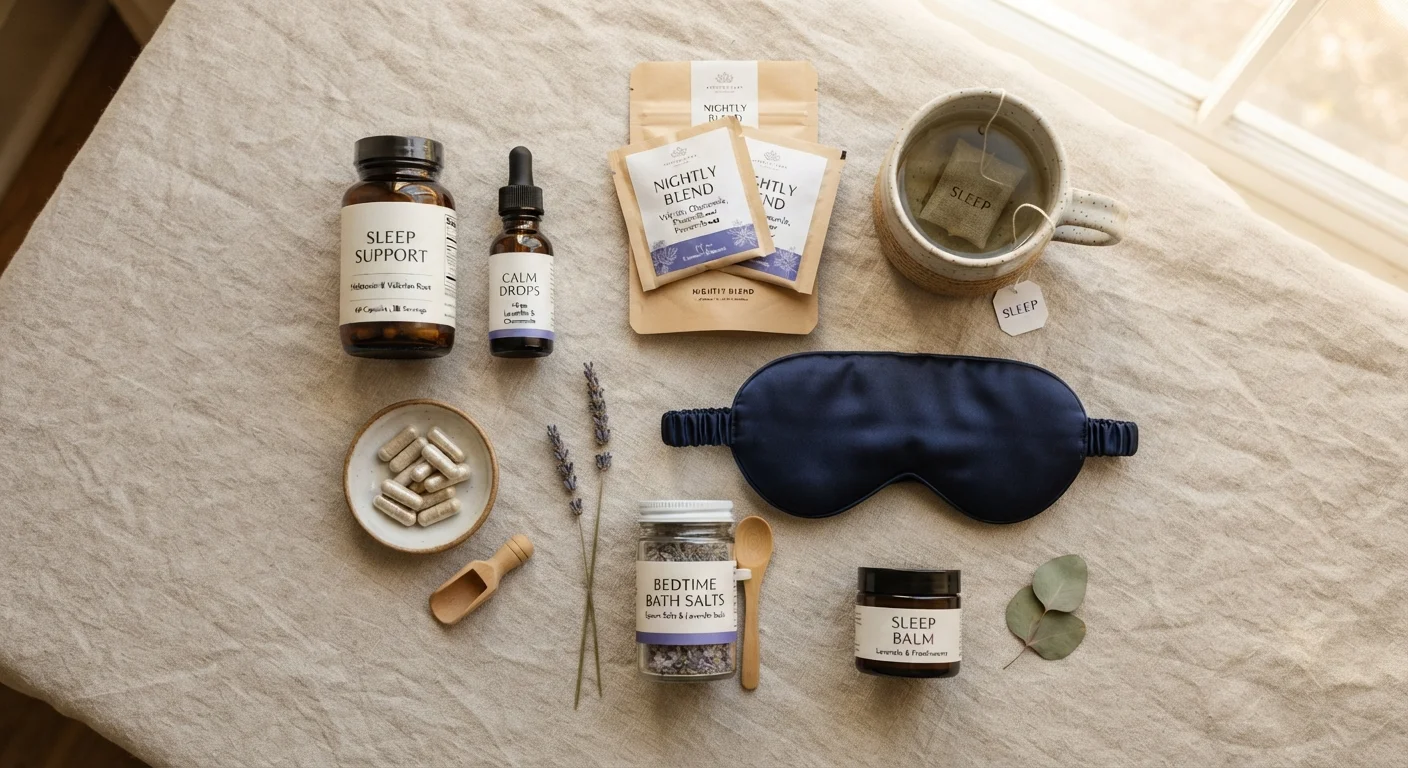
Key Takeaways
- Sleep support products vary widely - from melatonin and magnesium to herbal blends and non-ingestible devices.
- Most ingestible options are regulated as dietary supplements, not drugs, so pre-market efficacy proof is not required.
- Evidence quality differs significantly across product types; some have stronger research backing than others.
- Non-supplement tools like white noise machines and sleep masks carry lower risk profiles than ingestible products.
- Persistent sleep difficulties warrant evaluation by a healthcare professional, not just a product switch.
- Understanding what a product is - and what it isn't - helps you make more informed decisions before purchasing.
Sleep Support Products
Sleep support products are a broad category of supplements, herbal preparations, and non-ingestible aids marketed to help people fall asleep more easily, stay asleep longer, or improve overall sleep quality. They range from melatonin capsules and magnesium supplements to valerian root extracts and weighted blankets. Unlike prescription sleep medications, most are sold over the counter without a doctor's visit.
In the U.S., ingestible sleep products are typically classified as dietary supplements under the Dietary Supplement Health and Education Act (DSHEA), meaning they are not required to demonstrate efficacy before reaching store shelves.
What Falls Under the Sleep Support Umbrella
The term "sleep support products" covers a surprisingly wide range of items. To make sense of this category, it helps to break it into two broad groups: ingestible products (things you swallow) and non-ingestible aids (things you use in your environment or on your body).
Ingestible sleep products include single-ingredient supplements like melatonin and magnesium glycinate, herbal extracts such as valerian root, passionflower, and ashwagandha, and multi-ingredient blends that combine several of these. For a fuller picture of how dietary supplements as a category work, see our guide to dietary supplements.
Non-ingestible tools include weighted blankets, sleep masks, white noise machines, and blue-light-blocking glasses. These don't carry the same ingestion-related risk considerations but their effectiveness claims also deserve scrutiny. Understanding this distinction is the first step toward evaluating any product honestly.
Supplements Are Not a Substitute for Medical Evaluation
Sleep support products are intended for general wellness use, not for diagnosing or treating sleep disorders. Conditions like insomnia disorder, sleep apnea, and restless leg syndrome require clinical assessment. If your sleep difficulties are persistent or significantly affecting your daily life, please consult a healthcare provider rather than relying solely on over-the-counter products.
Key Ingredients and What Research Generally Suggests
Not all sleep supplement ingredients have the same level of scientific backing. Here's a factual overview of the most common ones:
- Melatonin: A hormone naturally produced by the body that signals nighttime. Supplemental melatonin has the most consistent research support for sleep-onset difficulties tied to circadian disruption - such as jet lag or shift work. Evidence for general insomnia is more modest.
- Magnesium glycinate: Magnesium plays a role in the nervous system and muscle relaxation. Some research suggests a link between magnesium deficiency and poor sleep, though evidence that supplementation meaningfully improves sleep in non-deficient individuals is limited.
- Valerian root: One of the most studied herbal sleep aids, but results across clinical trials are inconsistent. It's generally considered low-risk for short-term use in healthy adults, but its effectiveness remains debated among researchers.
- L-theanine: An amino acid found in tea, sometimes marketed for relaxation. Preliminary studies show possible effects on stress-related arousal, but large-scale sleep-specific trials are lacking.
- Ashwagandha: An adaptogenic herb more commonly associated with stress modulation. Some studies suggest a secondary benefit on sleep quality, particularly for people whose sleep is affected by stress. See our article on stress and mood wellness products for more context.
~9 million
U.S. adults using sleep aids regularly
CDC data has indicated that millions of American adults use some form of sleep aid, prescription or OTC, on a regular basis.
1 in 3
Adults not getting enough sleep
The CDC reports that roughly one-third of U.S. adults regularly sleep less than the recommended seven hours per night.
$billions
Annual U.S. sleep aid market size
Industry analysts consistently value the U.S. sleep supplement and aid market in the multi-billion dollar range, reflecting broad consumer demand.
Regulatory Context: What It Means for Shoppers
One of the most important things to understand about sleep supplements is how they're regulated. In the U.S., dietary supplements - including the vast majority of sleep products - are governed by the Dietary Supplement Health and Education Act (DSHEA) of 1994. Under this framework, manufacturers do not need to prove a product is effective before bringing it to market.
The FDA can act against a product after it's on shelves if it's found to be unsafe or mislabeled, but the burden of proof is different from what applies to pharmaceutical drugs. This means marketing language like "promotes restful sleep" or "supports healthy sleep cycles" is a structure/function claim, not a therapeutic promise backed by clinical data.
For a deeper look at how this regulatory landscape shapes what you see on store shelves, our article on wellness product regulation is a useful starting point. Third-party testing seals (such as those from USP, NSF International, or ConsumerLab) can provide some additional assurance about ingredient accuracy and purity, though they don't verify effectiveness claims.
Look for Third-Party Testing Certification
When evaluating ingestible sleep products, look for seals from independent testing organizations such as USP, NSF International, or ConsumerLab. These certifications indicate that the product has been tested for ingredient accuracy, potency, and absence of certain contaminants - though they do not verify that the product actually improves sleep. It's a useful quality signal, not an efficacy guarantee.
Before Products: The Case for Sleep Hygiene First
It's worth noting that behavioral and environmental changes remain the most consistently supported foundation for better sleep. The American Academy of Sleep Medicine and the CDC both highlight sleep hygiene - consistent sleep schedules, a dark and cool bedroom, limiting screen exposure before bed, and avoiding caffeine late in the day - as core interventions.
Products, at best, may complement these fundamentals for some people. At worst, they can become a reason to avoid addressing root causes. Our companion article on building a free sleep routine outlines the behavioral basics in practical terms.
If you're evaluating sleep products within a broader wellness strategy, the overview at what wellness products actually are provides helpful category-level context.
This article is for general informational and educational purposes only and does not constitute medical advice. If you are experiencing persistent sleep difficulties, consult a qualified healthcare provider for a proper evaluation and personalized guidance.