

Key Takeaways
- Dealer financing is convenient but often carries a markup above the rate lenders actually approve.
- Banks and credit unions typically offer more transparent rate structures and fewer add-on pressures.
- Getting pre-approved before visiting a dealership gives you negotiating leverage regardless of which lender you ultimately use.
- Credit unions frequently offer competitive rates for borrowers with limited or average credit histories.
- Total loan cost - not just monthly payment - is the number that matters most when comparing offers.
Our Verdict
Neither dealer financing nor outside lenders win in every situation. Dealer financing can be genuinely competitive, especially during manufacturer-backed rate promotions, but it requires careful scrutiny of the total cost. Banks and credit unions provide a useful benchmark and often better transparency. The strongest approach is to arrive at the dealership with a pre-approved offer in hand, then compare it against whatever the dealer presents.
| Best for | Recommended |
|---|---|
| Buyers who want a one-stop, fast transaction | Dealer Financing |
| Those prioritizing rate transparency and lower overall cost | Bank or Credit Union Loan |
| First-time buyers building credit with limited history | Credit Union Loan |
| Buyers qualifying for manufacturer-subsidized promotions | Dealer Financing |
How Each Financing Path Works
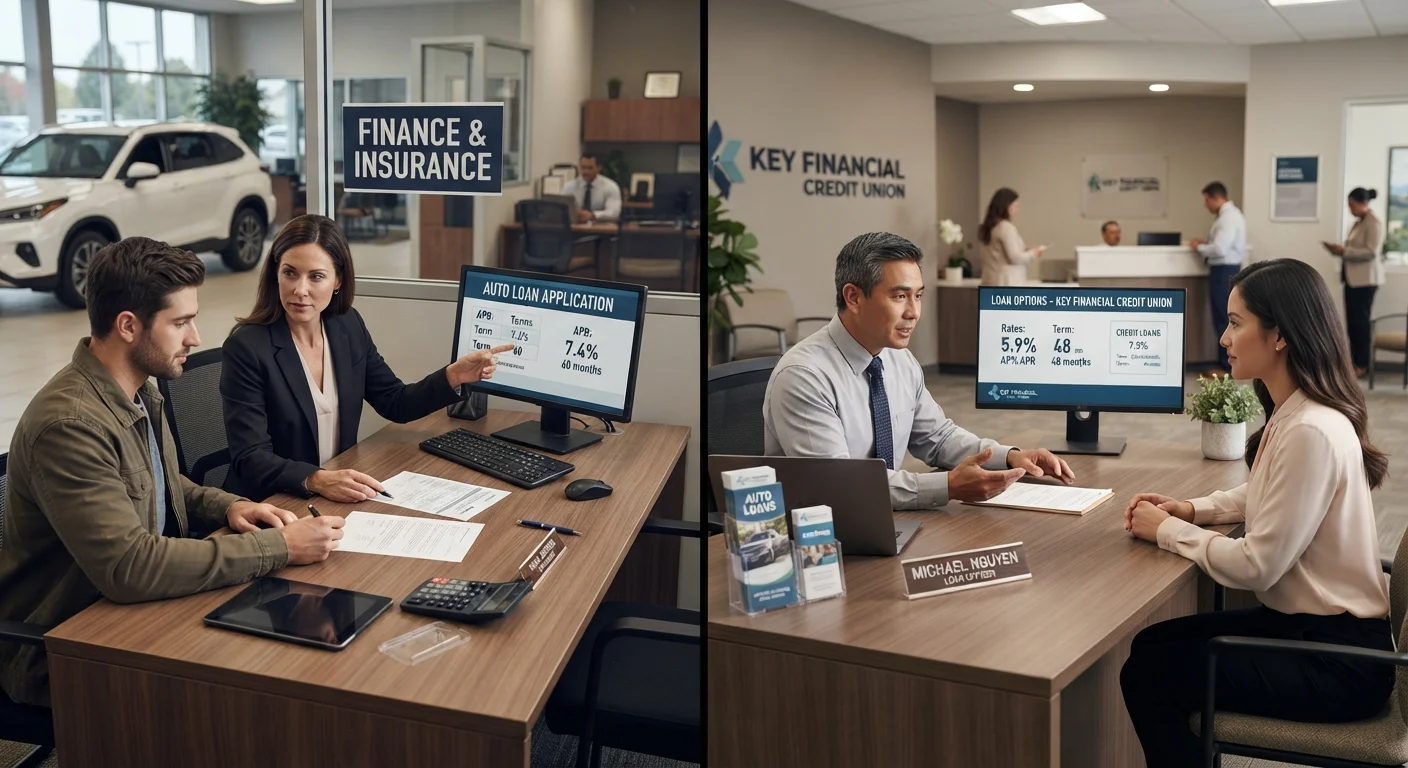
When you finance through a dealership, the dealer typically submits your credit application to multiple lenders in its network - banks, captive finance arms (lenders owned by automakers), and finance companies. The dealer then presents you with an offer, which may include a markup above the rate the lender actually approved. This markup, sometimes called a dealer reserve, is how the finance office generates revenue on the loan.
When you borrow from a bank or credit union directly, you apply for a loan before or after selecting a vehicle, receive a check or commitment letter, and then pay the dealer as if you were a cash buyer. Credit unions are member-owned nonprofits, which often translates to lower rates and fewer fees compared to traditional banks, though eligibility requirements vary by institution.
For a broader look at how financing fits into overall car ownership costs, see The Complete Picture of Car Ownership.
| Dealer Financing | Bank Loan | Credit Union Loan | |
|---|---|---|---|
| Convenience | High - handled at dealership | Moderate - apply separately | Moderate - apply separately |
| Rate Transparency | Lower - markup possible | High - rate shown directly | High - rate shown directly |
| Typical Rate Competitiveness | Varies; promotional rates possible | Competitive for good credit | Often lowest overall |
| Credit Flexibility | High - multiple lenders used | Moderate - varies by bank | Moderate - member-focused |
| Negotiating Leverage | Weaker without pre-approval | Strong with pre-approval | Strong with pre-approval |
| Add-on Product Pressure | Common in finance office | Minimal | Minimal |
Where Dealer Financing Has the Edge
Convenience is the clearest advantage. You select the vehicle, negotiate the price, and arrange financing in one visit. Dealers also sometimes offer manufacturer-subsidized rates - promotional APRs that are genuinely lower than what banks are offering at that moment. These deals are typically tied to specific models, model years, or credit tiers, so not every buyer qualifies.
Dealers also handle paperwork quickly and can accommodate buyers who have difficulty getting approved elsewhere, because they work with a wide range of lenders, including subprime finance companies.
The Monthly Payment Trap
Dealership finance conversations often center on monthly payment rather than total loan cost or vehicle price. A longer loan term can make a more expensive vehicle appear affordable while significantly increasing total interest paid. Always ask for the APR and total repayment amount in writing before agreeing to terms.
Where Banks and Credit Unions Have the Edge
Outside lenders compete for your business openly. A bank or credit union quote shows you exactly what rate and terms you qualify for, with no intermediary markup built in. That transparency makes comparison straightforward.
Getting pre-approved also shifts negotiating dynamics at the dealership. When you already have financing, the dealer knows you are not dependent on their finance office - which can sharpen the vehicle price negotiation itself. If the dealer then beats your pre-approved rate, you benefit either way.
Credit unions deserve particular attention. Because they are structured as member cooperatives rather than profit-driven companies, their auto loan rates are frequently lower than those of traditional banks, and their loan officers often take a more flexible view of credit history. If you are new to borrowing, Your First Car Loan: What to Understand Before You Sign walks through what lenders are actually evaluating.
~80%
New car buyers who use dealer financing
Industry estimates from the Consumer Financial Protection Bureau suggest a large majority of financed new-vehicle purchases are arranged through dealerships.
0.5-1.5%
Typical dealer rate markup range
Dealer reserve markups on approved lender rates have historically ranged from roughly half a percentage point to one and a half points, though practices vary by lender and regulation.
What to Watch for in Either Scenario
Regardless of where your loan originates, focus on the annual percentage rate (APR), the loan term in months, and the total amount repaid - not just the monthly payment. A longer term lowers monthly payments but increases total interest paid, and it can leave you underwater on the loan relative to the vehicle's depreciated value. How car depreciation affects your loan equity is worth understanding before you commit to any term.
In the dealer finance office, watch for add-ons - extended warranties, gap insurance, paint protection - bundled into the loan amount. These products may or may not be worthwhile, but rolling them into financing means you pay interest on them too. Ask for itemized pricing on each product separately before agreeing to anything.
If you are weighing the broader question of ownership versus leasing, Buying vs. Leasing a Car covers that comparison in detail. This article is for general informational purposes and does not constitute personalized financial or lending advice. Consult a licensed financial professional for guidance specific to your situation.
Apply to Multiple Lenders Before the Lot
Rate shopping for an auto loan within a short window - typically 14 to 45 days depending on the credit scoring model - is usually counted as a single inquiry on your credit report. Apply to your bank and at least one credit union before visiting dealers. You walk in informed, and any dealer offer has a real benchmark to beat.