

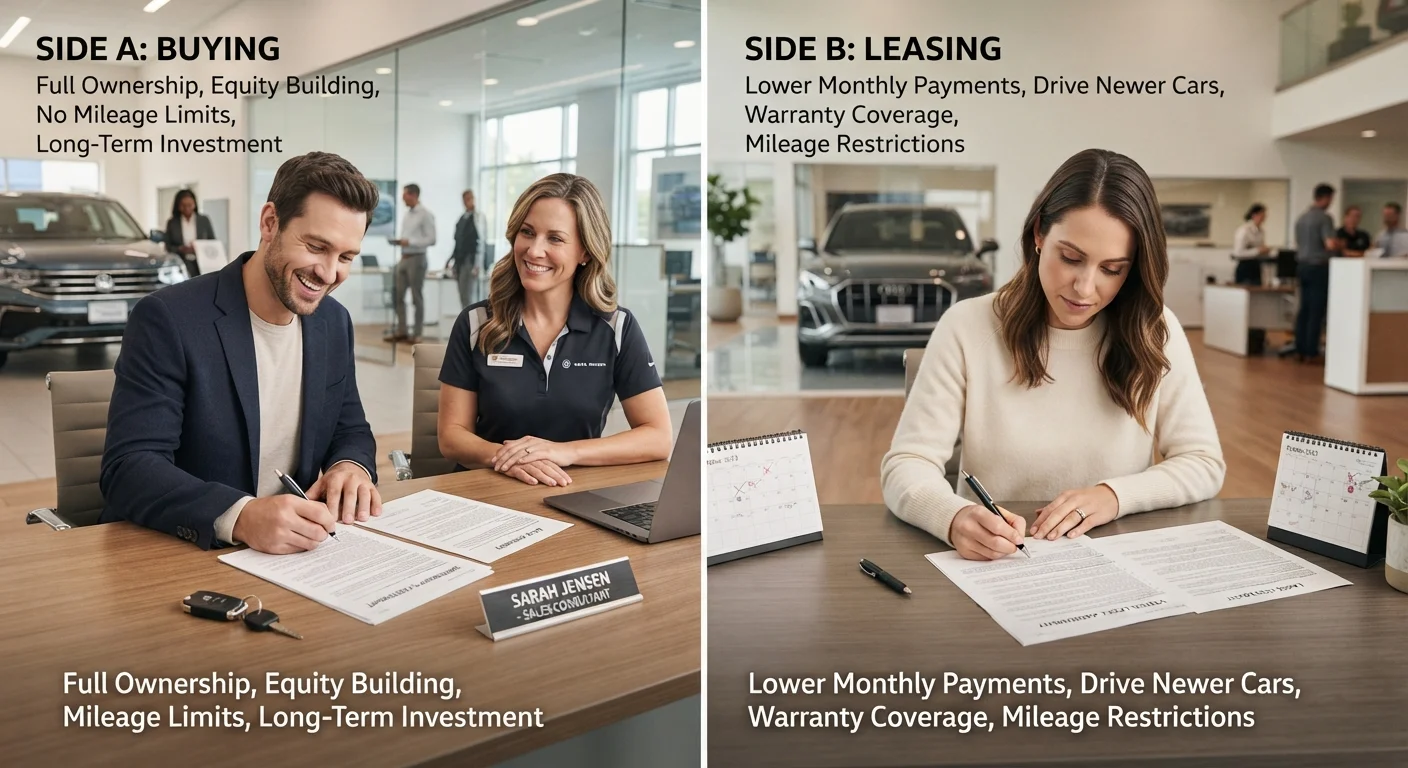
Key Takeaways
- Buying builds equity over time; leasing does not transfer ownership at term end.
- Lease agreements typically carry mileage limits - exceeding them triggers per-mile fees.
- Monthly lease payments are usually lower than loan payments for the same vehicle.
- Buyers carry long-term maintenance costs once the warranty expires; lessees often don't.
- Depreciation affects buyers most - it starts the moment you drive off the lot.
- Your driving habits, mileage, and financial goals should drive this decision.
Option A
Buying a Car
The long-term ownership path with full flexibility.
Best for: Drivers who want to build equity, put on high mileage, or keep their vehicle for many years without usage restrictions.
Option B
Leasing a Car
The lower-monthly-payment option with predictable terms.
Best for: Drivers who prefer driving newer vehicles on a regular cycle and keep their annual mileage within typical limits.
If you drive more than 15,000 miles per year
Buying a Car
Lease agreements typically cap annual mileage at 10,000-15,000 miles. Consistent overages can result in significant fees at turn-in, making ownership the more predictable option.
If you want lower monthly payments and a newer vehicle every few years
Leasing a Car
Lease payments are generally lower because you're only financing the vehicle's depreciation during the term, not its full value. You can cycle into a new model without navigating a private sale or trade-in.
If you plan to keep the vehicle for 8 or more years
Buying a Car
Once a loan is paid off, ongoing costs drop significantly. Long-term ownership almost always costs less over a decade than repeated leasing cycles.
If minimizing upfront costs is a priority
Leasing a Car
Leases typically require less cash at signing compared to a down payment on a purchase, freeing up liquid funds for other financial priorities.
If you modify vehicles or need full flexibility
Buying a Car
Leased vehicles must be returned in near-original condition. Owners face no such restrictions - they can modify, repaint, or sell whenever they choose.
How the Two Paths Actually Work
When you buy a car - whether with cash or a loan - you're acquiring an asset. Each payment on a financed vehicle builds equity, and once the loan is retired, you own the car outright. That ownership gives you full control: drive it, modify it, sell it, or keep it for 200,000 miles.
When you lease, you're essentially renting the vehicle for a set term, typically two to four years. Your monthly payment covers the vehicle's expected depreciation during that period plus fees and financing charges - not the full purchase price. At the end, you return the car or, in some lease structures, have the option to buy it at a pre-agreed residual value.
Understanding how depreciation works is foundational here. A vehicle can lose 15-25% of its value in the first year alone. Buyers absorb that loss directly; lessees are insulated from it during the lease term but never capture the remaining value either.
| Criterion | Buying | Leasing |
|---|---|---|
| Ownership | You own the vehicle outright after payoff | Lender retains ownership throughout |
| Monthly Payment | Typically higher (financing full value) | Typically lower (financing depreciation only) |
| Mileage Limits | None - drive as much as you want | Usually 10,000-15,000 miles/year; fees apply for overages |
| Upfront Costs | Down payment often required | Lower cash at signing typical |
| End-of-Term Options | Sell, trade in, or keep the vehicle | Return, buy out, or re-lease |
| Depreciation Risk | Fully absorbed by the owner | Lender bears residual-value risk |
| Customisation | Unrestricted | Generally prohibited |
| Long-term Cost (10+ years) | Lower - no payments after loan payoff | Higher - continuous lease payments |
The Real Cost Comparison: Beyond the Monthly Payment
Monthly payment comparisons can be misleading. A lease may look cheaper month-to-month, but the cumulative picture over 10 years often tells a different story - especially once you factor in that buyers eventually stop making payments while lessees do not.
~$600+
Average new-vehicle monthly loan payment (US)
According to Experian's State of the Automotive Finance Market reports, average new vehicle loan payments have consistently exceeded $600 in recent years.
15-25%
Typical first-year vehicle depreciation
Industry estimates consistently show new vehicles lose a significant portion of their value within the first 12 months of ownership.
2-4 years
Standard lease term length
Most automotive lease agreements in the US are structured for 24 to 48 months, with 36 months being among the most common terms offered.
Buyers also face costs that lessees often avoid during a lease term: out-of-warranty repairs, aging tires, and maintenance that accumulates on older vehicles. Our breakdown of the real costs of car ownership covers exactly how these expenses stack up beyond the sticker price.
Lessees, meanwhile, face their own financial exposure: disposition fees at turn-in, wear-and-tear charges if the vehicle has excess damage, and mileage overage penalties. These can add hundreds - sometimes thousands - of dollars to the final bill if not anticipated upfront.
Insurance requirements also differ. Leasing companies typically mandate higher liability and comprehensive coverage minimums than what a cash buyer might choose to carry. Factor that into your monthly cost estimate. For a full picture of how each choice affects your budget, the complete car ownership resource is worth reviewing before you sign anything.
Who Should Seriously Consider Each Option
This decision is personal and depends heavily on how you actually use a vehicle - not how you imagine you will.
Leasing tends to work well when:
- You drive a predictable, relatively low annual mileage (under 12,000-15,000 miles).
- You value having a vehicle under manufacturer warranty at all times.
- You prefer consistent, lower monthly payments and less exposure to repair costs.
- Your work or lifestyle benefits from regularly driving a newer model (e.g., certain business use cases where appearance matters).
Buying tends to make more financial sense when:
- You drive high annual mileage that would blow past any standard lease cap.
- You plan to keep the vehicle well past a typical loan term.
- You want full flexibility - no restrictions on use, modifications, or when you sell.
- You'd rather build equity and eventually own an asset outright, even a depreciated one.
If you're financing either path, the source of your loan matters too. See how dealer financing compares to bank or credit union loans before committing to a rate.
Business Use May Change the Equation
If you use a vehicle for self-employment or business purposes, both buying and leasing can have different tax implications. Lease payments and depreciation deductions are treated differently under US tax rules. A qualified tax professional can clarify what applies to your specific situation - general rules here don't substitute for personalised guidance.
This article is for general informational purposes only and does not constitute financial or legal advice. Consult a qualified financial professional before making significant financial decisions.