

Key Takeaways
- Applying products thickest-to-thinnest is the foundational rule of effective skincare layering.
- Heavy creams and oils applied first can physically block lighter serums from reaching the skin.
- Mixing certain active ingredients in the wrong order can cause irritation or neutralize their effects.
- A simpler routine applied correctly consistently outperforms a complex one applied haphazardly.
The Logic Behind Layering Order
Your skin has a straightforward preference: it absorbs lighter, water-based formulas more readily than thick, oil-based ones. That's the core principle guiding every well-sequenced routine. Products designed to deliver active ingredients — like serums packed with vitamin C or hyaluronic acid — are formulated to penetrate the upper layers of the skin. But if a dense moisturizer or facial oil is already sitting on top, those actives never get the chance.
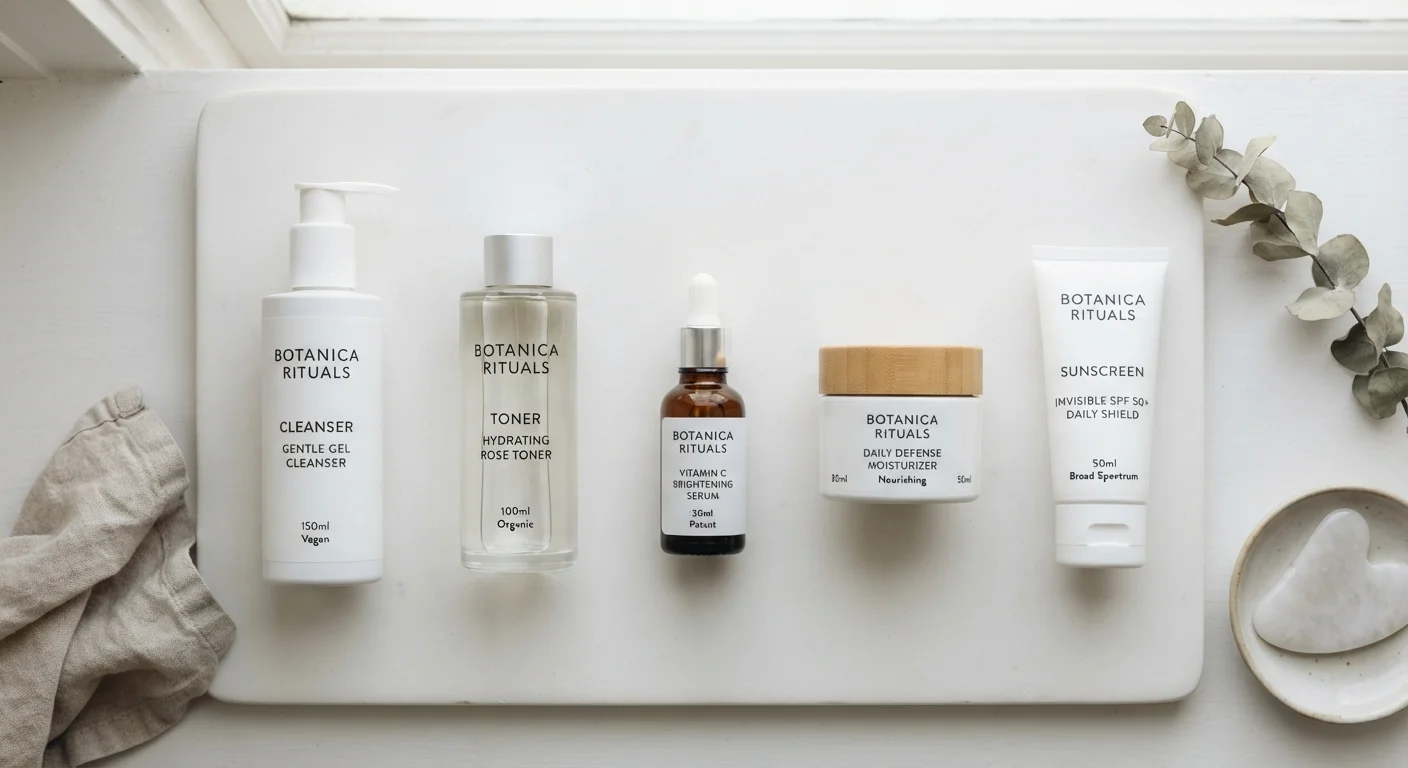
Think of it less like a stack and more like a relay race. Each product hands off to the next, and the order determines whether the baton ever reaches the finish line. A general framework that works for most routines: cleanser → toner or essence → targeted serums → eye cream → moisturizer → facial oil (if used) → SPF (morning only). Understanding why that order exists makes it much easier to adapt when you're adding a new product or simplifying on a busy night.
For a deeper look at what your individual ingredients are actually doing, decoding your product labels is a great starting point before building your sequence.
Applying a thick moisturizer before a serum.
Why it happens: Many people reach for hydration first instinctively, especially if their skin feels tight or dry after cleansing.
Layering a facial oil underneath a water-based product.
Why it happens: Oils feel luxurious and conditioning, so some people use them as a base. But oil and water don't mix — oil creates a barrier that water-based formulas cannot penetrate.
Using two potent actives back-to-back without considering compatibility.
Why it happens: More actives can feel like more results, and product marketing rarely explains interaction risks. Applying AHAs immediately before or after retinol, for example, can cause redness and sensitivity.
Skipping the wait time between layers.
Why it happens: Routines can feel time-consuming, and it's tempting to apply products in quick succession. However, layering too fast can cause pilling or dilute active concentrations.
Applying SPF before moisturizer in a morning routine.
Why it happens: Sunscreen is sometimes mentally filed under "skincare foundation," leading people to use it first. It is actually the final step in a daytime routine.
Putting It All Together Without Overcomplicating Things
One reassuring truth: you do not need a ten-step routine for healthy skin. A well-ordered three- or four-product routine will do more for your skin than a chaotic eight-step one. Once you understand the thin-to-thick rule and the active ingredient guidelines, sequencing becomes intuitive rather than stressful.
~60%
Topical absorption influenced by application order
Research in dermatology consistently notes that vehicle formulation and application sequence significantly affect how much of an active ingredient reaches its target skin layer.
3–4
Products in an effective minimal routine
Dermatologists generally agree that a cleanser, targeted treatment, moisturizer, and SPF cover the core needs for most skin types without overcrowding the routine.
If you're ever unsure about a new product, add it to your routine one step at a time and observe how your skin responds over a couple of weeks. This approach also makes it easier to identify what's causing a reaction if one develops. And if budget is a real factor — it is for most of us — a correctly layered minimal routine is far more cost-effective than buying additional products to compensate for a misdirected one. Building a smart routine on a budget covers exactly how to prioritize where your money goes.
It's also worth knowing that sequencing errors are one of several routine habits that quietly undermine results. Identifying counterproductive habits before layering on new steps is a principle that applies well beyond skincare.
This article is for general informational and educational purposes only. It is not a substitute for personalized advice from a licensed dermatologist or skincare professional. If you experience persistent skin irritation, reactions, or concerns, consult a qualified healthcare provider.