

Key Takeaways
- Both methods divide income into named spending categories before the money is spent.
- Cash stuffing creates a physical spending limit; digital envelopes enforce the same limit virtually.
- Cash stuffing eliminates overspending risk but makes online purchases and bill pay awkward.
- Digital envelope apps automate tracking but require consistent manual categorization to stay accurate.
- Neither method is objectively superior — the right fit depends on spending habits and lifestyle.
Option A
Cash Stuffing
The tactile, old-school approach to spending limits.
Best for: People who overspend with cards and need a physical boundary to make budgeting feel real.
Option B
Digital Envelope Budgeting
The app-powered version that mirrors cash envelopes without the bills.
Best for: People who prefer cashless convenience but still want the discipline of strict category limits.
If you consistently overspend on debit or credit cards
Cash Stuffing
Physically handing over cash creates a psychological friction point that card swipes do not. When the envelope is empty, spending stops automatically.
If most of your spending happens online or through subscriptions
Digital Envelope Budgeting
Managing online purchases with physical cash is cumbersome. A digital system tracks card and bank transactions against virtual category limits without disrupting how you already pay.
If you want to build a stronger awareness of where money goes
Cash Stuffing
Counting and allocating physical bills forces a deliberate engagement with your budget that passive app notifications rarely replicate.
If you share finances with a partner or household
Digital Envelope Budgeting
Most budgeting apps support shared accounts or synced views, making it easier for two people to track category balances without coordinating physical envelopes.
The Core Idea Behind Both Methods
Envelope budgeting is a straightforward principle: divide your income into spending categories at the start of each month and only spend what you've assigned to each category. Both cash stuffing and digital envelope budgeting follow this exact logic. The difference is the medium — paper and bills versus software and virtual balances.
The method gained mainstream attention through Dave Ramsey's financial guidance, but the underlying habit of pre-allocating money predates any branded system. The CFPB and many financial educators recommend zero-based budgeting approaches like this because they force intentionality: every dollar gets a job before it can be spent impulsively.
For a broader look at how envelope budgeting compares with percentage-based frameworks, see our comparison of the 50/30/20 rule and envelope budgeting.
| Criterion | Cash Stuffing | Digital Envelope Budgeting |
|---|---|---|
| Medium | Physical cash in labeled envelopes | App-based virtual category buckets |
| Spending friction | High — cash runs out visibly | Low — card swipes feel less immediate |
| Online purchase compatibility | Awkward; requires workarounds | Seamless; tracks card transactions |
| Security risk | Lost or stolen cash unrecoverable | Protected by bank/app security |
| Setup effort | Manual; requires ATM withdrawals | Initial app setup; ongoing categorization |
| Shared household use | Difficult to coordinate | Easier with shared app access |
| Behavior reinforcement | Strong — tangible and visual | Moderate — relies on checking the app |
How Each Method Works Day-to-Day
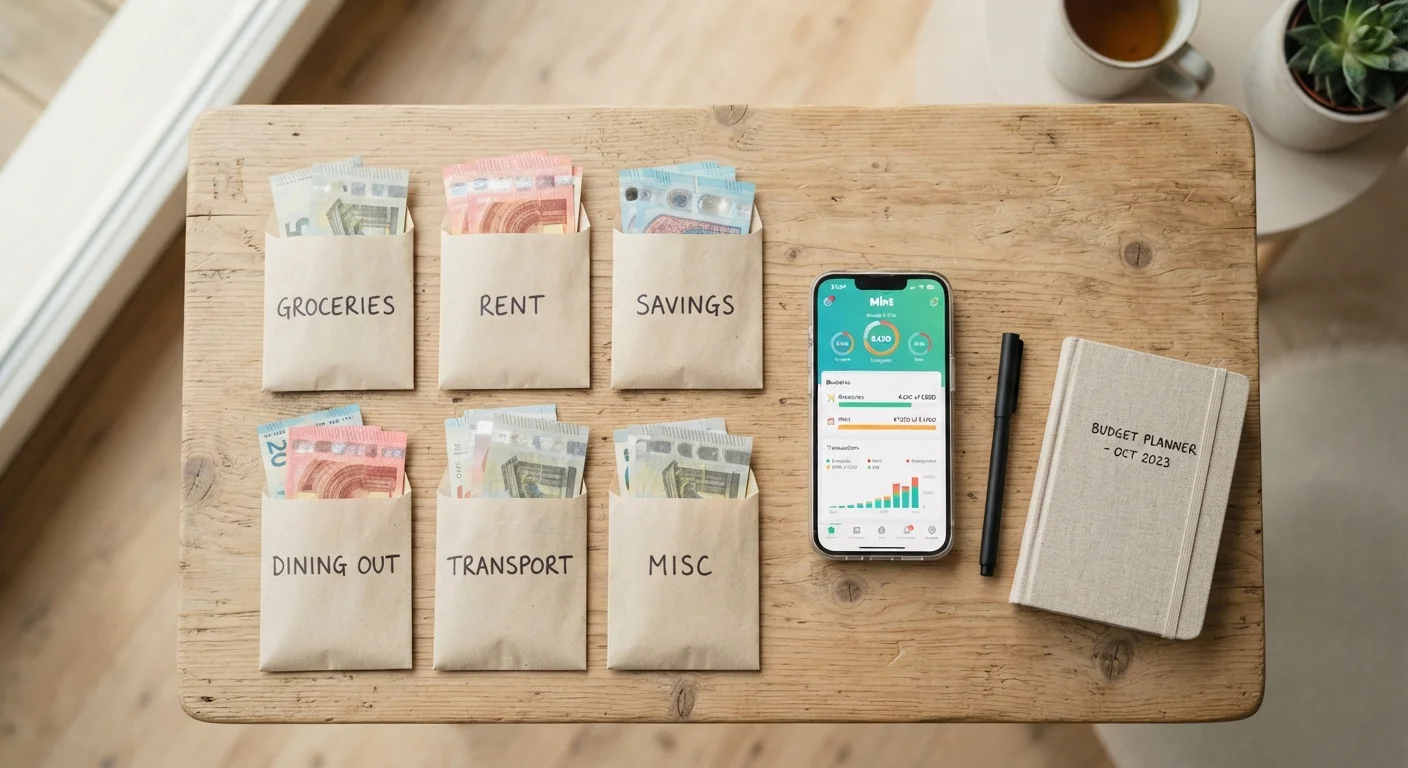
Cash stuffing in practice: After each paycheck, you withdraw the month's discretionary budget in cash and physically sort it into labeled envelopes — groceries, dining out, gas, clothing, and so on. When you shop, you bring only the relevant envelope. Once it's empty, that category is done for the month. Fixed bills like rent or utilities are typically paid by check or autopay separately, since handling those in cash adds unnecessary complexity.
Digital envelope budgeting in practice: Apps designed around this method — general examples include zero-based budgeting tools that link to your bank account — let you create virtual category buckets and assign income to each one. As transactions clear, you match them to the correct envelope. Some apps pull transactions automatically; others require you to enter purchases manually. Either way, the category balance updates in real time, and you can check your "grocery envelope" balance just as you would peek inside a physical one.
If you're still deciding how to track spending overall, our guide to spreadsheets vs. budgeting apps covers the broader trade-offs.
~33%
Americans with a detailed monthly budget
A Gallup poll found roughly one-third of U.S. adults maintain a detailed household budget, suggesting most people lack a structured spending plan of any kind.
82%
U.S. transactions made without cash
Federal Reserve payments research indicates that the vast majority of U.S. consumer transactions are now cashless, which creates practical challenges for pure cash-stuffing systems.
Real Trade-Offs Worth Knowing
Cash stuffing carries a few practical disadvantages that are easy to overlook. Carrying significant cash raises safety concerns. ATM fees can chip away at savings if withdrawals are frequent. Cash also earns nothing sitting in an envelope, whereas money left in a bank account may earn a modest interest rate. And if an envelope is lost or stolen, that money is gone.
Digital envelope budgeting sidesteps those problems but introduces its own friction. The system only works if transactions are categorized consistently and promptly. A week of ignored notifications can leave your category balances wildly inaccurate. There's also a behavioral gap: swiping a card and seeing a number drop in an app simply doesn't carry the same psychological weight as handing over physical bills — a pattern supported by consumer behavior research on payment transparency.
Both methods also require you to account for irregular expenses. Things like car registration, annual insurance premiums, or veterinary bills can blow up any envelope system if you haven't created sinking fund categories for them. See our article on spending categories most budgets overlook for a practical checklist.
Hybrid Approaches Are Common
Many people combine both methods: they use cash envelopes for the categories where they tend to overspend most — such as dining out or personal spending money — and manage fixed or online expenses through a digital system. There's no rule requiring you to pick one approach exclusively. The goal is a system you'll actually stick with, not a perfectly pure methodology.
This article is for general informational and educational purposes only and does not constitute personalized financial advice. Consider consulting a qualified financial professional for guidance tailored to your individual circumstances.