

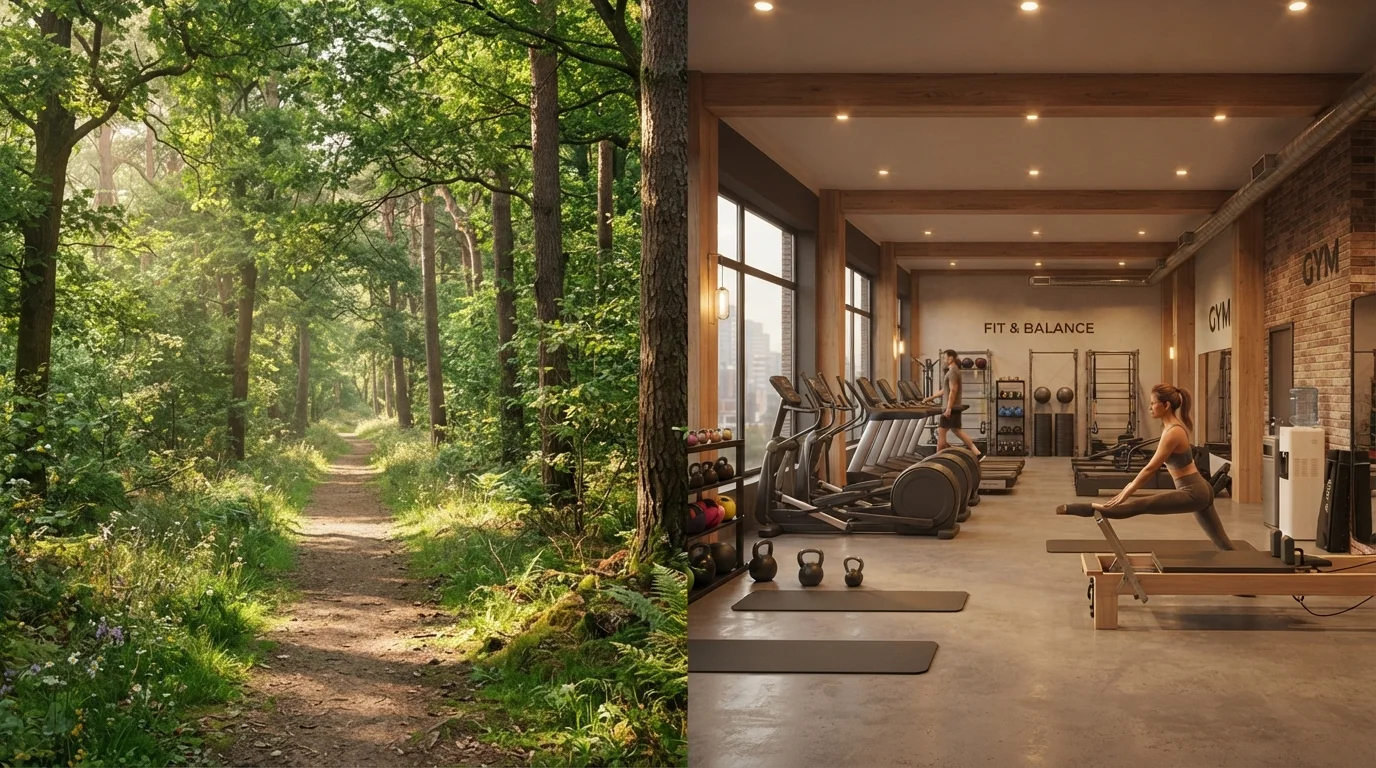
Key Takeaways
- Outdoor time uniquely supports mental health through nature exposure, independent of physical effort.
- Indoor exercise generally allows more targeted, progressive physical training with less weather dependency.
- Combining both approaches captures benefits that neither delivers as well on its own.
- Neither option requires significant spending - both can be practiced at low or no cost.
- Individual health context matters; consult a healthcare professional for personalized guidance.
Option A
Outdoor Time
Nature-based movement and exposure with built-in mental health benefits.
Best for: People seeking stress relief, vitamin D, and low-cost daily movement in natural settings.
Option B
Indoor Exercise
Structured, controlled physical training with measurable fitness outcomes.
Best for: People pursuing specific fitness goals, consistent year-round routines, or supervised training.
If stress and mental fatigue are your primary concern
Outdoor Time
Research consistently links nature exposure to reduced cortisol levels and lower perceived stress, even at low activity intensities.
If you want structured cardiovascular or strength gains
Indoor Exercise
Controlled environments enable progressive overload, consistent pacing, and access to equipment designed for measurable fitness improvement.
If cost and accessibility are your biggest barriers
Outdoor Time
Public parks, trails, and sidewalks are free and widely available, requiring no membership or equipment for basic movement.
If you live in a climate with harsh winters or extreme heat
Indoor Exercise
Indoor settings remove weather as a barrier, helping you maintain consistency year-round - a key factor in long-term wellness.
If you want a well-rounded daily wellness routine
Outdoor Time
Layering outdoor movement into an existing indoor routine adds mood, sleep, and vitamin D benefits without duplicating effort.
What Each Approach Actually Offers
Outdoor time and indoor exercise are often treated as substitutes - swap one for the other based on the weather. But they work on your body and mind through meaningfully different pathways, which means choosing between them isn't simply a matter of preference.
Outdoor time encompasses any activity done in natural or semi-natural environments - walking a trail, gardening, sitting in a park, or cycling on a greenway. The wellness effects come from two distinct sources: the physical movement itself and the nature exposure. Sunlight supports vitamin D synthesis and helps regulate circadian rhythms. Research published in environmental health journals suggests time in green spaces is associated with reduced markers of stress and improved mood, even when the activity level is low.
Indoor exercise refers to structured physical activity in a controlled setting - gyms, home workout spaces, studios, or community centers. The core advantage is control: you can regulate intensity, track progress, and train specific muscle groups or cardiovascular systems without weather interference. This predictability is particularly valuable for people following a rehabilitation plan or working toward defined fitness benchmarks.
See our comparison of walking versus structured exercise for a deeper look at how activity type influences daily health outcomes.
| Criterion | Outdoor Time | Indoor Exercise |
|---|---|---|
| Mental stress relief | Strong - nature exposure adds distinct benefit | Good - via exercise-driven endorphins |
| Vitamin D support | Yes - sunlight exposure | No - artificial lighting |
| Weather dependency | High - seasonally limited | None - year-round consistency |
| Fitness progression | Requires deliberate effort to structure | Easier - equipment enables progressive overload |
| Typical cost | Low to none | Variable - free to moderate gym fees |
| Social opportunity | Informal - trails, parks | Structured - classes, gym community |
| Circadian rhythm support | Yes - natural light cues | Limited without morning outdoor exposure |
The Mental Health Dimension: Where Outdoors Has the Edge
One of the clearest distinctions between these two approaches is their effect on psychological well-being. Indoor exercise absolutely supports mental health - physical activity of any kind is associated with reduced symptoms of anxiety and depression, according to guidance from the CDC and major psychiatric organizations. But outdoor settings add a layer that four walls and mirrors simply cannot replicate.
The concept of attention restoration - developed in environmental psychology - proposes that natural environments allow the directed attention we use for tasks and screens to recover passively. Spending time in green or blue spaces (parks, water, forests) appears to replenish cognitive resources in a way that urban or indoor environments do not. This is separate from the exercise effect.
20 min
Outdoor time linked to lower stress hormones
A study in Frontiers in Psychology found that as little as 20 minutes in a natural setting was associated with significant reductions in salivary cortisol.
150 min
Weekly moderate activity recommended by CDC
The CDC recommends at least 150 minutes of moderate-intensity aerobic activity per week for most adults, achievable indoors or outdoors.
~42%
U.S. adults with vitamin D insufficiency
Research published in Nutrition Research estimated that a significant share of American adults have insufficient vitamin D levels, partly linked to limited sunlight exposure.
For people experiencing low-grade burnout or mental fatigue, outdoor time may deliver stress relief more efficiently per minute than equivalent indoor activity. That said, individuals managing diagnosed mental health conditions should work with a qualified healthcare provider rather than relying on environmental changes alone.
For context on building sustainable habits around either approach, the article on consistency versus intensity is worth reviewing.
Physical Fitness: Where Structure Matters
When the goal is measurable fitness improvement - increased cardiovascular capacity, muscle strength, or weight management - indoor exercise tends to offer more reliable tools. Treadmills, resistance equipment, and group fitness formats allow for progressive overload, the principle of gradually increasing training demands that drives physical adaptation.
Outdoor movement is excellent for baseline physical activity but is less easily structured for progression. A daily walk is valuable and well-supported by public health recommendations, but it does not automatically build the same cardiovascular or muscular adaptations as a graduated aerobic or strength program.
Intensity Can Happen Anywhere
The location of your workout matters less than the effort you bring to it. Outdoor settings can support high-intensity training just as effectively as a gym when approached with intention. Trail running, hill sprints, and resistance-band workouts in a park all qualify as vigorous activity under standard public health definitions. The environment shapes context and mood - your effort shapes the fitness outcome.
That said, outdoor activities like trail running, cycling, swimming, or bodyweight circuits in a park can absolutely reach intensities that deliver structured fitness benefits - the environment doesn't cap the effort. The distinction is more about default behavior: most people move more casually outdoors and more intentionally indoors.
If you're building or refining a wellness routine, it's also worth examining what habits might be undermining your efforts. The editorial on wellness habits worth dropping offers a practical starting point.
This article is for general informational and educational purposes only and does not constitute medical advice. Consult a qualified healthcare professional before making changes to your physical activity routine, especially if you have an existing health condition.