

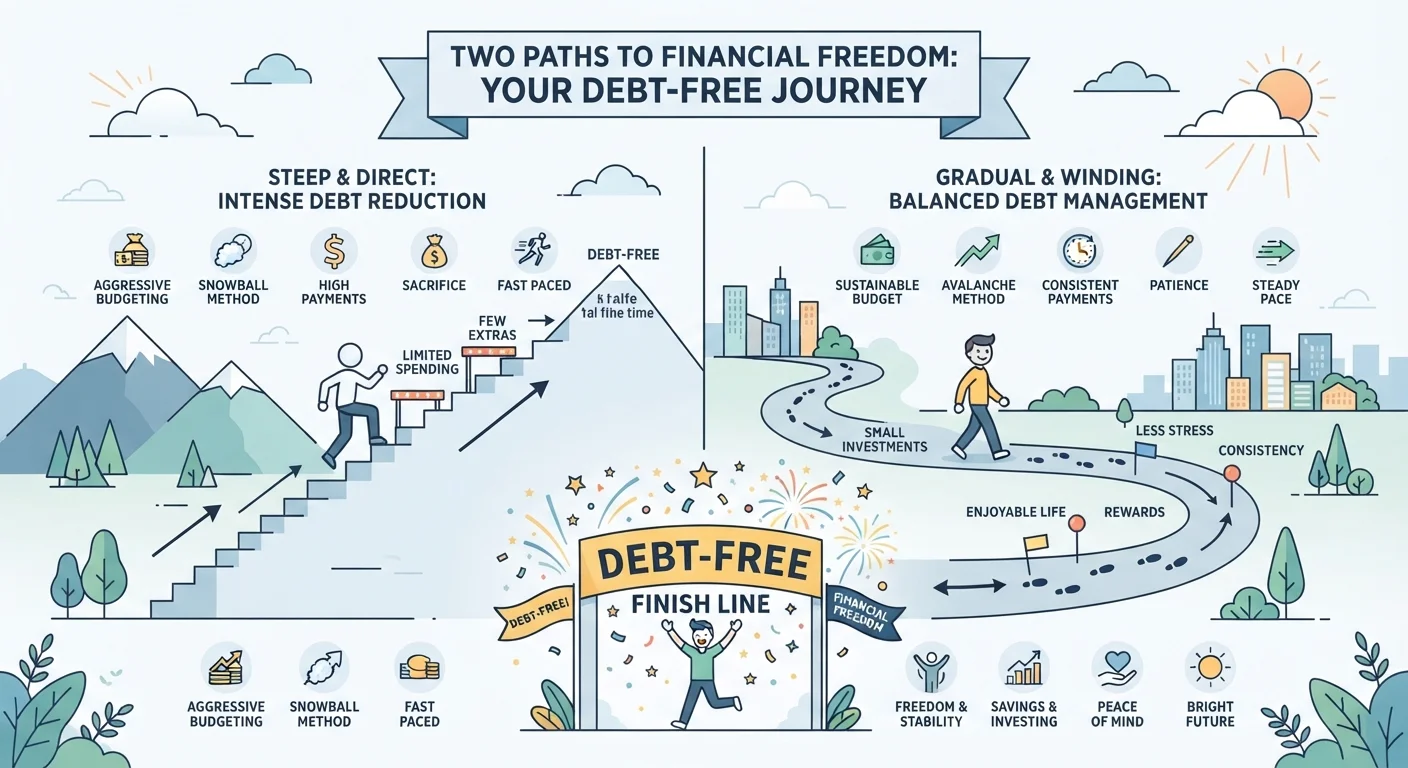
Key Takeaways
- The debt avalanche targets the highest-interest debt first, minimizing total interest paid over time.
- The debt snowball targets the smallest balance first, generating early wins that help sustain motivation.
- Both methods require paying minimums on all debts and directing extra funds to one priority account.
- Research suggests behavior and consistency matter as much as mathematical efficiency in debt payoff.
- Your best strategy is whichever one you can realistically stick with month after month.
Option A
Debt Avalanche
The mathematically optimal, interest-minimizing approach.
Best for: People who are motivated by long-term savings and can stay disciplined even when early progress feels slow.
Option B
Debt Snowball
The momentum-driven, psychologically rewarding approach.
Best for: People who need quick wins and emotional motivation to stay consistent with a payoff plan.
If you carry high-interest credit card balances and want to save the most money overall
Debt Avalanche
Targeting your highest-rate debt first reduces total interest charges significantly, especially when rates are well above 15–20%.
If you've struggled to stay motivated or have abandoned debt payoff plans before
Debt Snowball
Clearing smaller balances quickly creates visible progress, which behavioral research consistently links to higher follow-through rates.
If your debts carry similar interest rates but vary widely in balance size
Debt Snowball
When rates are close, the interest-cost difference between strategies shrinks, making the motivational edge of the snowball more valuable.
If you have one debt with a dramatically higher interest rate than all others
Debt Avalanche
A significantly higher-rate debt can compound quickly; attacking it first prevents the most expensive portion of your debt from growing.
How Each Strategy Actually Works
Both methods share the same mechanical foundation: pay the minimum required on every debt each month, then direct any extra dollars toward a single priority account. The difference is in how you choose that priority account.
Debt Avalanche: Rank your debts from highest to lowest interest rate. Put every extra dollar toward the highest-rate balance first. Once it's gone, roll that payment into the next highest-rate debt, and so on. Because you're eliminating the most expensive debt first, you pay less total interest over the life of your payoff plan.
Debt Snowball: Rank your debts from smallest to largest balance, regardless of interest rate. Attack the smallest balance first with your extra funds. Once it's cleared, roll that freed-up payment into the next smallest. Each eliminated debt adds momentum — like a snowball gaining size as it rolls downhill.
If you're just beginning to organize your finances, the starter guide to saving and managing debt covers how to take inventory of what you owe before choosing a repayment path.
| Criterion | Debt Avalanche | Debt Snowball |
|---|---|---|
| Priority order | Highest interest rate first | Smallest balance first |
| Total interest paid | Lower (mathematically optimal) | Potentially higher |
| Time to first debt eliminated | Often longer | Often shorter |
| Motivational style | Discipline and long-term focus | Quick wins and momentum |
| Best interest rate scenario | Large gaps between rates | Similar rates across debts |
| Complexity | Requires tracking APRs | Simple balance ranking |
The Math vs. The Psychology
On paper, the avalanche wins. By eliminating high-interest debt first, you reduce the amount of interest accruing across your entire debt load — potentially saving hundreds or thousands of dollars compared with the snowball approach, depending on your balances and rates.
But personal finance research complicates this picture. A study published in the Journal of Consumer Research found that people who focused on paying off individual accounts — rather than reducing total debt — were more likely to eliminate all their debt. The snowball's quick wins appear to reinforce the habit of making extra payments, which is ultimately what matters most.
22.8%
Average credit card interest rate (APR)
The Federal Reserve reported average credit card APRs exceeding 22% in recent years, underscoring the urgency of targeting high-rate debt.
$6,000+
Median credit card balance per U.S. household
According to Federal Reserve consumer credit data, revolving balances carried by indebted households often exceed several thousand dollars.
Neither strategy works if you stop following it. If the avalanche's slow early progress causes you to disengage, the math advantage disappears entirely. Conversely, if you're highly disciplined and rate-focused, the snowball may leave money on the table unnecessarily.
For a broader look at balancing debt payoff with other financial goals, see how to pay off debt while saving at the same time.
When to Consider a Different Path Entirely
Both strategies assume you're working with your existing debts at their current rates. In some situations, restructuring the debt itself — before choosing a payoff order — may make more sense.
Debt consolidation combines multiple balances into one, potentially at a lower interest rate, which can make either payoff method more efficient. Similarly, using a personal loan to pay off debt is an option some borrowers explore — but it carries its own risks worth understanding first.
Hybrid Approaches Are Valid
Some people combine both strategies — clearing one small balance first for a motivational boost, then switching to the avalanche method for the remaining debts. There's no rule requiring you to follow one approach exclusively. What matters is that your method is consistent and sustainable within your actual budget and habits.
Your debt-to-income ratio also matters if you plan to apply for new credit or refinancing while paying down balances — lenders weigh this figure heavily when evaluating applications. Building a workable budget alongside your payoff strategy is equally important; the budgeting basics hub offers practical frameworks to get there.
This article is for general informational and educational purposes only. It does not constitute personalised financial advice. Consider consulting a licensed financial professional for guidance specific to your situation.