

Key Takeaways
- Recurring subscriptions and forgotten fees drain savings without triggering a conscious spending decision.
- Treating credit card rewards or sale prices as 'free money' typically leads to net overspending.
- Deferred irregular expenses — car repairs, medical copays — often become debt when they finally arrive.
- Lifestyle creep quietly absorbs income gains before they can reach a savings account.
- Convenience spending adds up faster than most budgets anticipate, especially across multiple categories.
Why Savings Goals Stall Without Obvious Mistakes
Most people who struggle to save aren't making dramatic financial errors. They're not gambling away paychecks or making reckless purchases. Instead, they're caught in a slower drain — a cluster of small, habitual spending patterns that feel normal in the moment but compound over time into a meaningful gap between income and savings.
Research from the Consumer Financial Protection Bureau (CFPB) consistently shows that a significant share of Americans carry little or no liquid savings, even among households with moderate to higher incomes. The culprit is rarely a single decision — it's the accumulated weight of repeated patterns that never get examined.
Understanding which patterns are most likely to erode progress is the first step toward addressing them. These aren't moral failures; they're behavioral tendencies that nearly everyone shares. Recognizing them makes them easier to interrupt. See also: common savings myths that reinforce these habits without people realizing it.
Start With a 90-Day Spending Audit
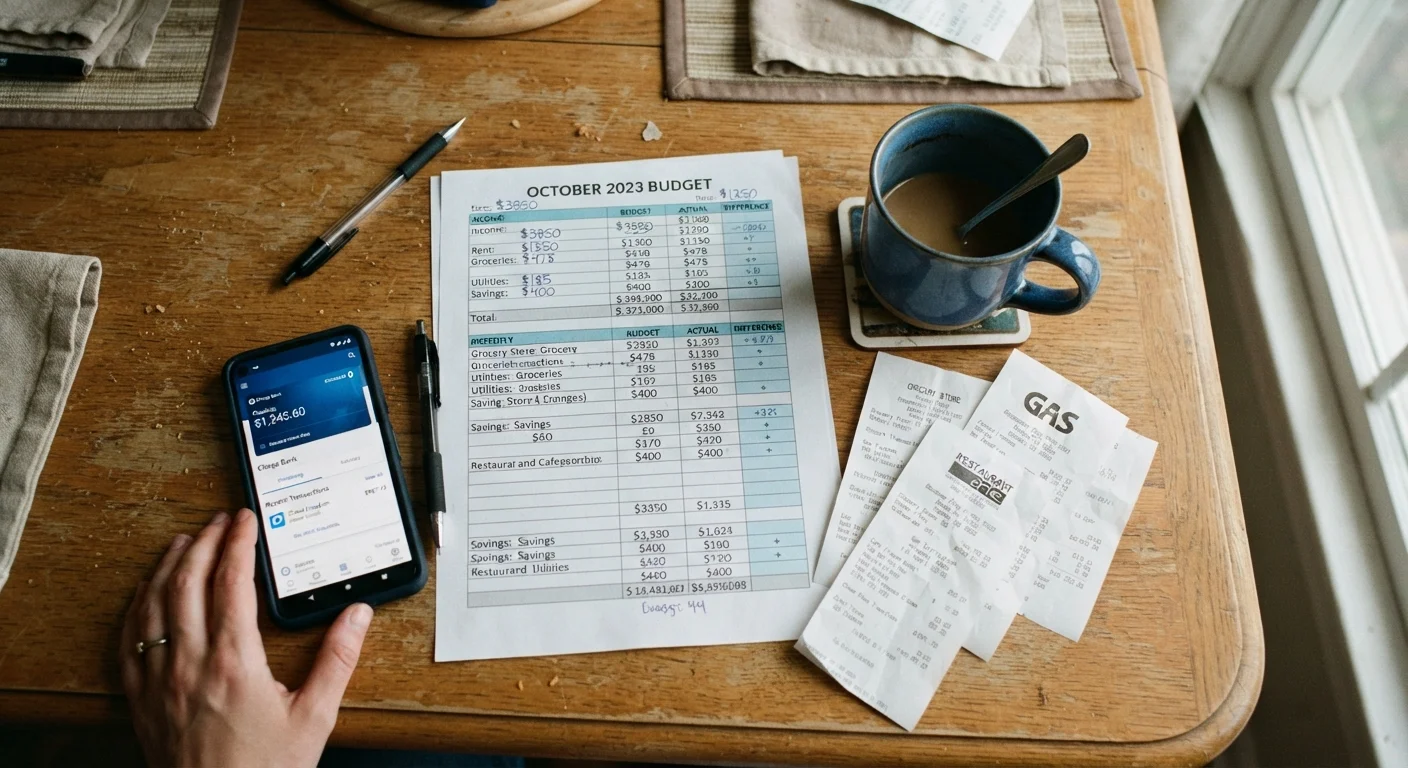
Pull three months of bank and credit card statements and group transactions into categories. Patterns that are invisible week-to-week become clear when you see them accumulated. Even a rough categorization — recurring charges, food, convenience, discretionary — is enough to identify where the quiet leaks are.
This article is general financial education and is not personalized financial advice. For guidance specific to your situation, consult a licensed financial professional.
Patterns That Silently Chip Away at Savings
Subscription accumulation you've stopped noticing
Streaming services, fitness apps, cloud storage tiers, news sites, software tools — individually, each feels affordable. Collectively, they can easily exceed $150–$200 per month for households that haven't done a recent audit. The specific problem isn't any single subscription; it's that automatic renewals eliminate the moment of decision that would otherwise prompt reconsideration.
A quarterly review — checking bank and credit card statements for recurring charges — is a practical way to catch services that have outlived their usefulness. See our related piece on spending categories most budgets overlook for a broader list of easy-to-miss recurring costs.
Automatic renewals eliminate the moment of decision that would otherwise prompt reconsideration.
Treating sale prices as a savings event
Buying something at 40% off that you wouldn't have bought at full price isn't saving — it's spending 60% of a discretionary cost you didn't plan for. This framing is especially common with clothing and retail, where promotional pricing is the norm rather than the exception.
The psychological pull of a discount is real and well-documented in behavioral economics research. Recognizing that a lower price doesn't create purchasing need — it just reduces the friction around an unplanned expense — is a useful mental shift. Overspending in the name of savings covers this pattern in more detail.
A lower price doesn't create purchasing need — it just reduces friction around an unplanned expense.
Ignoring irregular but predictable expenses
Annual car registration, semi-annual insurance premiums, back-to-school shopping, holiday gifts — these costs aren't surprises in the true sense. Most households know they're coming. But without a plan to save for them in advance, they arrive as budget shocks that get charged to a credit card or pulled from emergency savings.
Setting aside a small, fixed amount each month toward these predictable costs — often called a sinking fund — converts a lump-sum shock into a manageable routine. Sinking funds are a straightforward tool for exactly this purpose.
Most irregular expenses aren't surprises — they're costs that arrived without a savings plan behind them.
Convenience spending across multiple small categories
Food delivery fees, airport snacks, last-minute ride shares, vending machine purchases — none of these individually move the needle. But convenience spending tends to cluster: if you're using delivery services regularly, you're also likely paying for similar convenience in other areas. Bureau of Labor Statistics Consumer Expenditure data shows food-away-from-home is consistently one of the largest discretionary categories in American household budgets.
The goal isn't to eliminate convenience spending — it's to make it intentional. Knowing roughly what you spend in this category monthly prevents it from being a perpetual budget leak.
Convenience spending clusters — one habit rarely exists without several others alongside it.
Letting income growth absorb into lifestyle costs
When income increases — through a raise, a bonus, or a side income — the default for many households is that spending expands to match it. This pattern, sometimes called lifestyle creep, means that despite earning more, the gap between income and savings stays roughly the same or narrows.
The most effective counter-strategy is to direct a portion of any income increase toward savings before it integrates into the monthly budget. Lifestyle creep is worth understanding explicitly, because it operates gradually and rarely feels like a conscious choice.
Lifestyle creep operates gradually and rarely feels like a conscious choice while it's happening.
Deferring maintenance until costs escalate
Skipping a dental cleaning, postponing a car's minor repair, or ignoring a slow plumbing issue to avoid the upfront cost typically results in a larger bill later. This is a false economy: the short-term cash saved gets outpaced by the eventual cost of a bigger problem. Deferred maintenance costs often end up on credit cards, adding interest charges on top of an already inflated repair bill.
Budgeting a modest monthly amount for home and vehicle upkeep — even when nothing needs fixing — creates a reserve that makes proactive maintenance financially viable. Why skipping small repairs leads to big bills illustrates this cycle in the context of vehicle ownership specifically.
Deferring maintenance rarely saves money — it typically converts a small expense into a larger, debt-funded one.
Small Amounts Do Add Up — Both Ways
The same compounding logic that makes small savings grow over time also works in reverse: small, repeated expenditures accumulate into significant annual totals. A $12/month charge that goes unnoticed costs $144 a year. Five of those charges equal $720 — enough to meaningfully seed an emergency fund. Micro-saving strategies use this same math in your favor.
Turning Awareness Into Action
None of these patterns require a dramatic lifestyle overhaul to address. The most effective approach is usually a focused audit: pull three months of bank and credit card statements and categorize spending honestly. Patterns become visible quickly when you see them in aggregate rather than one transaction at a time.
From there, small structural changes — automating a savings transfer before discretionary spending begins, setting a calendar reminder to review subscriptions quarterly, or building a sinking fund for predictable irregular costs — tend to be more durable than willpower-based strategies. For a broader look at habits that support long-term financial stability, consistent systems matter more than occasional effort.
This article is for general informational and educational purposes only and does not constitute personalized financial advice. Consult a qualified financial professional before making decisions about your specific financial situation.