
Actual Cash Value vs. Replacement Cost Value: The Difference That Determines Your Claim Check

Key Takeaways
- ACV subtracts depreciation from a property's value, often leaving a significant gap between your payout and what replacement actually costs.
- RCV covers the full cost to replace damaged property with a new equivalent, regardless of the item's age.
- RCV policies typically carry higher premiums than ACV policies due to the greater potential payout.
- Some RCV policies initially pay ACV and release the remaining 'recoverable depreciation' only after you complete repairs.
- Your policy's declarations page will specify which valuation method applies - always read it before you need to file a claim.
Option A
Actual Cash Value (ACV)
The depreciation-adjusted valuation method.
Best for: Policyholders seeking lower premiums who can absorb the gap between a payout and full replacement costs.
Option B
Replacement Cost Value (RCV)
The full-replacement valuation method.
Best for: Homeowners and renters who want their claim payout to cover the actual cost of replacing damaged property with a comparable new item.
If you want maximum financial protection after a major loss
Replacement Cost Value (RCV)
RCV ensures you can actually replace what was lost without covering a large out-of-pocket gap caused by depreciation. This matters most for roofs, appliances, and electronics.
If keeping monthly premiums as low as possible is the priority
Actual Cash Value (ACV)
ACV policies carry lower premiums. This may make sense if you have savings to bridge the gap between a depreciated payout and full replacement costs.
If you own older property or an aging vehicle
Actual Cash Value (ACV)
When property is already heavily depreciated, the premium savings of ACV may outweigh the reduced payout, particularly if replacement isn't a priority.
If your mortgage lender requires it
Replacement Cost Value (RCV)
Many lenders require homeowners to carry RCV coverage to protect the collateral securing the loan. Check your loan agreement for specific requirements.
What These Terms Actually Mean
When you file a property insurance claim - whether for storm damage to your roof, a break-in, or a kitchen fire - your insurer calculates what to pay you using one of two methods: Actual Cash Value (ACV) or Replacement Cost Value (RCV). Which method your policy uses can easily mean a difference of thousands of dollars on the same claim.
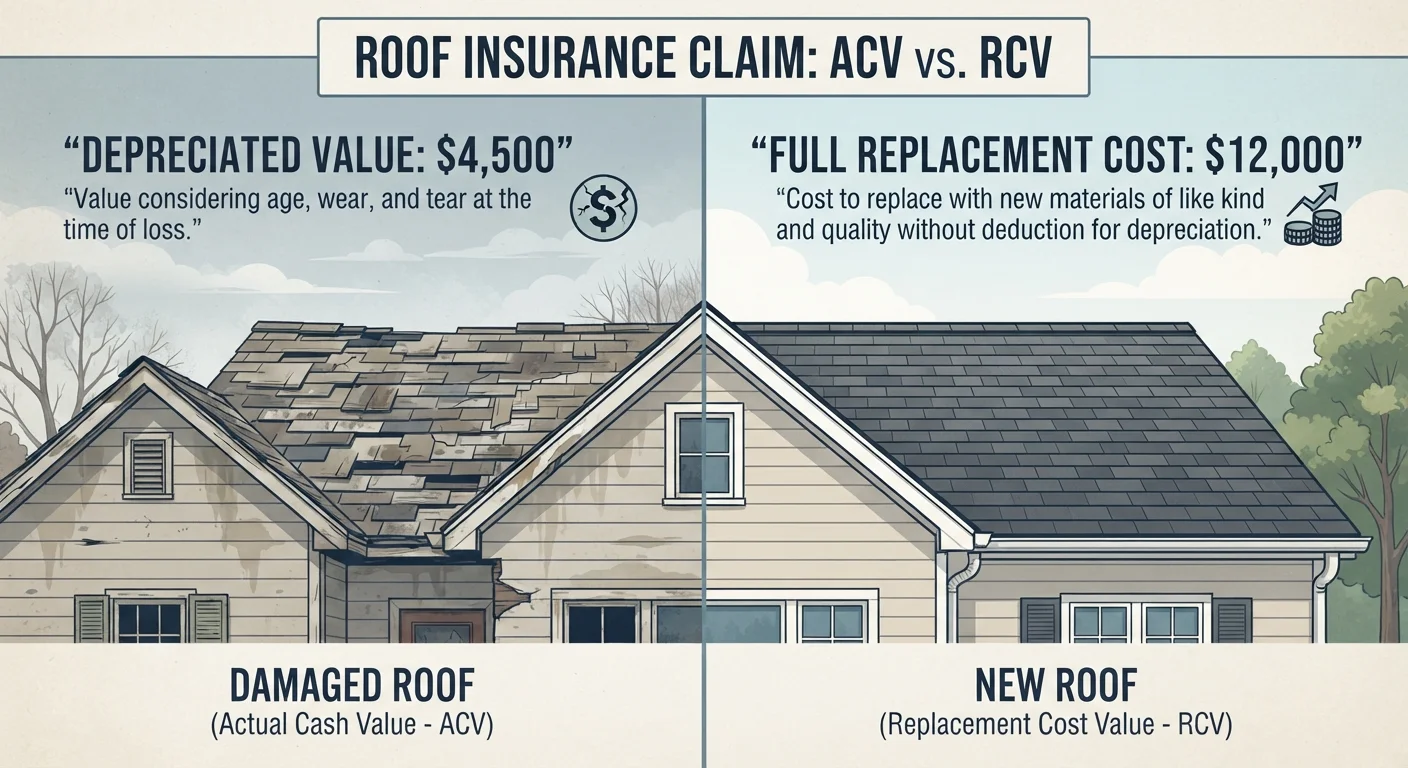
Actual Cash Value is what the damaged property was worth at the time of the loss, factoring in depreciation. Depreciation accounts for age, wear, and obsolescence. A five-year-old laptop or a fifteen-year-old roof has lost value since it was new, and ACV captures that reduced worth.
Replacement Cost Value ignores depreciation. Instead, it pays what it would cost to replace the damaged property with a new item of similar kind and quality - at today's prices. No age penalty applied.
For a plain-language breakdown of additional claims terminology, see our Insurance Claims Vocabulary reference guide.
| Criterion | Actual Cash Value (ACV) | Replacement Cost Value (RCV) |
|---|---|---|
| Depreciation applied | Yes - reduces payout | No - full cost covered |
| Typical premium cost | Lower | Higher |
| Out-of-pocket gap after claim | Potentially large | Minimal (after deductible) |
| Payout timing | Single payment | Often two-step (ACV first, then recoverable depreciation) |
| Best suited for | Budget-conscious, older property | Maximum protection, newer property |
| Repair completion required | No | Often required to collect full amount |
How Each Method Is Calculated
Understanding the math helps you anticipate what a claim check might look like before disaster strikes.
ACV formula (simplified): Replacement Cost minus Depreciation equals ACV. Insurers apply depreciation based on the item's expected useful life and its current age. A roof with a 20-year lifespan that is 10 years old might be depreciated by 50%.
Example: A covered hailstorm destroys your roof. A comparable new roof costs $15,000. With a 50% depreciation factor and a $1,000 deductible, an ACV policy pays approximately $6,500. You cover the remaining $7,500 out of pocket.
RCV payout (same scenario): $15,000 minus the $1,000 deductible equals $14,000. The depreciation gap disappears entirely.
One important nuance: many RCV policies use a two-step payout. The insurer first releases the ACV amount. Once you complete and document the repairs, they release the held-back depreciation - called recoverable depreciation. If you don't make the repairs, you typically keep only the ACV portion. This is a common source of confusion; our article on common claims misconceptions covers this and other payout surprises in detail.
50%+
Depreciation on a mid-life roof claim
A roof at the halfway point of its rated lifespan can be depreciated by half or more under ACV calculations, based on standard insurer depreciation schedules.
$7,000+
Typical ACV vs. RCV gap on a roof claim
Industry estimates suggest the difference between an ACV and RCV payout on an average residential roof replacement can easily exceed $7,000 depending on material and depreciation.
2-step
Common RCV payment structure
Many RCV policies withhold recoverable depreciation until repairs are completed and documented, requiring policyholders to fund work before receiving the full payout.
Where to Find This in Your Policy
Your policy's declarations page (sometimes called the "dec page") is the one-to-two page summary at the front of your policy documents. It lists your coverage types, limits, deductibles, and - critically - the valuation method used for your dwelling, personal property, or both. Look for language like "replacement cost," "actual cash value," or sometimes "ACV" written directly next to each coverage line.
Personal property coverage and dwelling coverage don't always use the same method. A policy might cover the structure of your home on an RCV basis while covering your furniture and electronics on an ACV basis. Read each line separately.
If the language is unclear, your insurer is required to explain it. Ask specifically: "Will my personal property be paid on an actual cash value or replacement cost basis?" Get the answer in writing. Also review the policy's conditions section for any requirements - such as completing repairs - before recoverable depreciation is released.
This article is general insurance education and is not personalized advice. Coverage terms, exclusions, and payout rules vary by insurer and state. Always read your policy documents carefully and consult a licensed insurance agent for guidance specific to your situation.